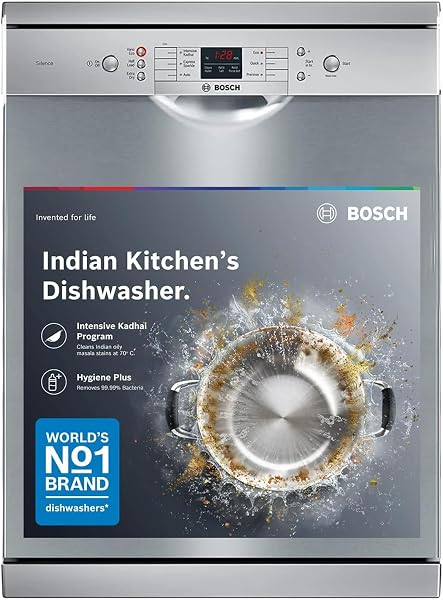
Midea 13 Place Setting Freestanding Dishwasher: India Buying Guide, Prices & Honest Verdict (2025)

About Rahul Verma: Rahul is a tech enthusiast and gadget reviewer with over 8 years of experience testing consumer electronics. He specializes in audio gear, smartwatches, and mobile accessories. When he is not testing products, you will find him exploring the latest in AI and smart home technology.

If you have ever stood at the sink at 10:30 PM staring down a mountain of dal-stained katoris, greasy kadhai and a sink full of chai cups, you already know why dishwashers have quietly moved from "luxury" to "sanity-saving appliance" in Indian homes. And if you have been researching seriously, you have almost certainly run into the Midea 13 place setting freestanding dishwasher — the model that consistently undercuts Bosch and IFB by ₹8,000–₹15,000 while offering the same 13-place capacity.
The question is not whether it looks good on paper. The question is whether a Chinese-built dishwasher with a thinner service network makes sense for your kitchen, your water supply and your family size. This guide breaks down everything: what 13 place settings actually means in an Indian household, what the Midea 13 place setting freestanding dishwasher does well and where it cuts corners, current street prices across Amazon, Flipkart and offline chains, the running cost per wash, and the exact timing tricks to get the best deal.
Understanding the Midea 13 Place Setting Freestanding Dishwasher
Before we get into models, price points and comparisons, let's decode the three parts of that product name, because each one matters in a very practical way when you're standing in your kitchen measuring a 60 cm gap.
What "13 place settings" really means
A "place setting" is a standardised European measure — roughly one dinner plate, one side plate, one bowl, one glass, one cup and saucer, and a set of cutlery. Thirteen place settings translates to roughly 130–160 individual utensils in one load. In practical Indian terms, that's a full day of cooking and eating for a family of 4–5, including the pressure cooker lid, the mixer jar (if it fits), two kadhais, serving bowls and the inevitable stack of steel glasses.
Here's the nuance most buyers miss: Indian households use smaller vessels — katoris, steel tumblers, idli plates — which pack tighter than European dinnerware. So a 13 place setting machine often handles what a Western family would need a 14 or 15 place machine for. Conversely, if you cook elaborate meals with large pressure cookers and big non-stick pans, those bulky items eat into the usable capacity fast.
Why "freestanding" is the right choice for most Indian homes
Freestanding models need no carpentry, no modular kitchen modification and no dedicated cabinetry — they slide into any 60 cm wide gap, under a counter or against a wall. You need three things: a 60 cm × 60 cm floor footprint, a standard 15 A power socket within reach, and a cold water inlet tap nearby (plus a drain point). Because they are not built-in, you can also take the machine with you if you shift homes. The trade-off is purely cosmetic — the front panel is visible rather than flush with your cabinets.
Where Midea fits in the Indian market
Midea is one of the world's largest appliance manufacturers (it also makes components and complete units for several well-known brands). In India, it entered with air conditioners and washing machines and expanded into dishwashers at aggressively low price points. The midea 13 place setting freestanding dishwasher sits at the value end of the 13-place segment — roughly ₹10,000–₹18,000 below a comparable Bosch, and ₹5,000–₹10,000 below IFB or Voltas Beko.
Midea 13 Place Setting Freestanding Dishwasher: Models and Price Points
Midea's India lineup changes every few quarters, and the same machine sometimes appears under slightly different model codes across marketplaces. Below is how the options typically stack up, along with realistic street prices (not MRP) as observed on Amazon India, Flipkart and large-format retail stores.
1. Midea 13 Place Setting Freestanding Dishwasher (core model, ~₹23,000–₹29,000)
This is the machine most buyers end up with — a full-size 60 cm freestanding unit with a stainless steel tub, 8 wash programs, a half-load option and a delay-start timer. Typical listed specifications include a 3-star BEE energy rating, water consumption in the 10–13 litre range per full cycle, a noise level around 49–52 dB, and a height of about 84–85 cm (which matters — see the fitment section below). MRP is usually printed around ₹34,000–₹38,000, but it is discounted almost year-round. During festive sales you can often see it drop toward ₹21,000–₹23,000 with bank offers.
Best for: Budget-conscious families buying their first dishwasher, nuclear families of 3–5, and anyone who wants 13-place capacity without paying Bosch money.
2. Midea 12 Place Setting variant (~₹19,000–₹24,000)
Worth knowing about because sellers sometimes push it as an "almost identical, cheaper" option. The 12-place version usually loses a wash program or two and may use a slightly simpler drying system. Unless the price gap is ₹4,000 or more, the 13-place version is the better buy — the extra basket space genuinely matters when a pressure cooker body needs to go in.
3. Midea 14 / 15 Place Setting variants (~₹30,000–₹36,000)
Occasionally available on Flipkart and in Croma or Reliance Digital stores. These add capacity and sometimes a third rack for cutlery. Only worth it if you regularly cook for 6+ people or entertain often. For most Indian homes, the 13-place unit is the sweet spot.
If you want to compare beyond Midea
Nothing exists in a vacuum. If your budget stretches, these are the realistic alternatives you should physically compare against the Midea 13 place setting freestanding dishwasher before checking out.
Comparison Table: Midea vs the Main 13-Place Rivals
| Model | Place Settings | Approx. Street Price | Standout Feature | Best For |
|---|---|---|---|---|
| Midea 13 Place Setting Freestanding Dishwasher | 13 | ₹23,000–₹29,000 | Lowest price per place setting, 8 programs, half-load | Value buyers, first-time dishwasher owners |
| Bosch SMS66GI01I | 13 | ₹46,000–₹52,000 | Zeolite drying, near-silent operation, huge service network | Buyers who want zero hassle for 8–10 years |
| Voltas Beko DF13S1 | 13 | ₹27,000–₹33,000 | Strong Indian service footprint, wide model availability | Buyers in tier-2/tier-3 cities |
| IFB 13 Place Setting (Neptune series) | 13 | ₹30,000–₹36,000 | Reliable build, good drying, established brand trust | Buyers upgrading from an IFB washing machine |
| Whirlpool 14 Place Setting | 14 | ₹27,000–₹32,000 | Extra capacity, PowerClean jets, wide retail presence | Joint families with heavy daily loads |
Prices are indicative and fluctuate with marketplace offers, bank discounts and festive sales. Always verify the current listing before buying.
Key Features That Actually Matter
Wash programs: quantity is not quality
The Midea 13 place setting freestanding dishwasher typically lists 8 programs — Intensive, Normal, Eco, Glass, Rapid/Quick, Soak/Pre-wash, 90-minute and sometimes an Auto mode. In real Indian use, you will use three: Intensive for greasy masala pans and burnt-bottom vessels, Normal for the everyday load, and Rapid for a quick refresh of lightly soiled cups and glasses. The remaining programs are nice to have but rarely touched. Don't let a rival's "10 programs" sway you.
Drying: the honest weak point of budget dishwashers
Midea units generally rely on residual heat drying — the final rinse uses hot water and the machine lets steam escape, so utensils come out hot and air-dry over 15–20 minutes. Steel and glass dry beautifully. Plastic tiffin boxes and melamine will still have water droplets. If you open the door immediately after the cycle and let it air for a few minutes, results improve noticeably. Premium rivals offer active door-opening or zeolite drying; that is a real advantage but comes at nearly double the price.
Water and energy consumption
Most 13-place Midea models are listed with a 3-star BEE rating and consume roughly 10–13 litres of water and 1.0–1.3 kWh of electricity per full Intensive/Normal cycle. An Eco cycle can pull that down to under 1 kWh. Compare that with handwashing a family-of-four's daily utensils under a running tap, which typically uses 30–45 litres. Water savings are dramatic; electricity savings versus heating water in a geyser are more modest but real.
Noise levels
Around 49–52 dB, which is roughly the sound of a quiet conversation. If your kitchen opens directly into the living room, an open-plan home, or you like running the machine while watching TV at night, this is fine but not whisper-quiet. Bosch units at this capacity run closer to 44 dB. If silence matters more than cost, factor that in.
Baskets, cutlery and loading flexibility
Two main baskets plus a cutlery basket or tray. Look for an adjustable upper basket (you can raise it to fit tall pressure cooker bodies or lower it for a tall stockpot) and fold-down plate racks. Cheaper variants may have a fixed upper basket — always check the listing photos before ordering, because this is the single biggest load-flexibility feature.
Midea 13 Place Setting Freestanding Dishwasher: Pros and Cons
What it does well
- Unbeatable price-to-capacity ratio. You get genuine 13-place space for ₹23,000–₹29,000 — money that would buy you a 12-place or smaller unit from most other brands.
- Stainless steel tub. Better hygiene and heat retention than the plastic tubs found on some budget machines.
- Half-load option. Crucial for Indian families who don't fill 13 places every single day, especially on days you eat out or order in.
- Delay start. Useful if your society has time-of-day electricity tariffs or if you want the machine to finish before you wake up.
- Straightforward build. Fewer electronic bells and whistles means fewer things to fail — and simple mechanical parts are easier for technicians to service.
Where it falls short
- Service network depth. This is the biggest genuine concern. Midea's authorised service partners are strong in metros (Delhi NCR, Mumbai, Bengaluru, Hyderabad, Chennai, Pune, Ahmedabad) but thin in smaller towns. If you're in a tier-3 city, confirm the nearest service centre in writing before purchase.
- Residual heat drying only. Expect to towel-dry plastic items.
- Slightly louder than premium German rivals.
- Resale value and brand recall are lower than Bosch or IFB, which matters if you might resell in 4–5 years.
- No auto-door-open drying on the core 13-place model.
Buying Guide: What to Check Before You Swipe Your Card
Measure your kitchen gap — including the skirting
A standard freestanding dishwasher is 60 cm wide × 60 cm deep × 84–85 cm tall. Indian modular kitchens frequently have countertops at 85–87 cm with a plinth (skirting) that eats 8–10 cm of usable depth. Measure the actual clear opening, not the drawing in your modular kitchen file. If your gap is 84 cm and the machine is 85 cm, it simply won't slide in — and returning a dishwasher is a logistical nightmare.
Water hardness — the make-or-break factor
Dishwashers in India live or die by hard water. If your area's TDS is above 300–400 ppm, you must use dishwasher salt and check that the model has a salt container with an adjustable hardness setting. Skip this and you will see white chalky film on glasses within two months, and the heating element will scale up. Test your water with a cheap TDS meter (₹200 on Amazon) before you buy anything. If TDS is very high, budget for a dedicated salt supply — roughly ₹150–₹200 a month.
Warranty: read the fine print
Midea typically offers 2 years comprehensive warranty on the machine, sometimes with extended coverage on the wash motor. Confirm two things in writing: (a) whether the warranty is honoured by Midea India directly or only through the seller, and (b) whether installation charges are included or billed separately (usually ₹500–₹1,000). Also check whether the listing is sold by a Midea-authorised seller — greymarket imports lose service support entirely.
Detergent, salt and rinse aid
Budget ₹400–₹700 a month for consumables. Use a quality tablet or powder (Finish, Cascade, Midea's own) — cheap unbranded powders foam excessively and can damage the pump. Salt is non-negotiable in most Indian cities. Rinse aid is what gives you sparkling, streak-free glasses and it is genuinely worth the ₹250 per bottle.
Power and plumbing
You need a 15 A socket with earthing within about 1.5 m of the machine. A voltage stabiliser is advisable if your area sees frequent fluctuations. The inlet connects to a cold water tap via a diverter — many buyers fit a simple two-way tap so the sink remains usable. Drainage can be gravity-fed into the sink line if the hose reaches, or connected to a dedicated standpipe.
Real-World Usage Tips for Indian Households
Marketing brochures are written for European kitchens. Here is what actually works when you're dealing with ghee, haldi, chai stains and last night's biryani handi.
- Scrape, don't rinse. Knock solids into the bin and give badly burnt pans a 10-minute soak. Full pre-rinsing under a tap wastes the very water you bought the machine to save.
- Load pans face-down and at an angle. Water sprays from two rotating arms — if a vessel is flat-faced upward, it collects water instead of draining.
- Run the Intensive cycle for pressure cookers and kadhais, Normal for plates and bowls. Don't run Intensive daily;
Affiliate Disclosure:
This post contains affiliate links. We may earn a commission when you purchase through our links, at no extra cost to you.
Share this: