Panasonic 23L Convection Microwave OvenNN-CT353BFDG Review: Is This ₹15,000 Convection Worth It?

About Rahul Verma: Rahul is a tech enthusiast and gadget reviewer with over 8 years of experience testing consumer electronics. He specializes in audio gear, smartwatches, and mobile accessories. When he is not testing products, you will find him exploring the latest in AI and smart home technology.
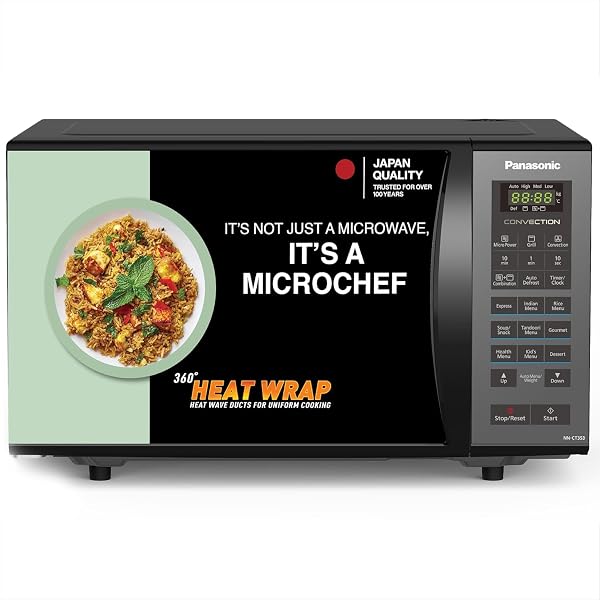
If you've been hunting for a convection microwave that can bake, grill and reheat without eating up half your kitchen counter, the panasonic 23l convection microwave ovennnct353bfdg has almost certainly popped up in your Amazon or Flipkart search results. It sits in that awkward-but-interesting middle band — more capable than a budget solo microwave, but a good ₹10,000 cheaper than the premium 32L convection ovens that LG and Samsung push.
So is it the right machine for your kitchen? That depends on three things: how often you actually bake, how many people you cook for, and whether you want "101 auto cook menus" or just a reliable oven that doesn't confuse you.
In this guide, we break down the Panasonic 23L Convection Microwave Oven NN-CT353BFDG feature by feature — real specs, honest limitations, current price bands across Amazon and Flipkart, and how it stacks up against alternatives at ₹10,000, ₹15,000 and ₹20,000. By the end, you'll know exactly whether to buy it, wait for a sale, or pick a different model altogether.
Understanding the Panasonic 23L Convection Microwave Oven NN-CT353BFDG
Let's clear up the confusion first, because "convection microwave" gets used loosely in Indian retail listings.
The Panasonic NN-CT353BFDG is a three-in-one appliance. It is a microwave (for reheating and defrosting), a grill (for tandoori-style charring and cheese melts), and a convection oven (for baking cakes, cookies, pizzas and roasts). Panasonic sells it as part of the "CT" series, where the "353" denotes the platform and "BFDG" is the finish/variant code — in this case, a glossy black body with a mirrored door.
Here's the crucial part most buyers miss: a convection microwave is not the same as an OTG. An OTG (oven-toaster-griller) uses exposed heating elements and gives you better browning, larger capacity for the money, and simpler mechanics. A convection microwave adds microwave reheating and defrosting on top, but generally offers less usable oven volume and a steeper learning curve for baking. If you already own a microwave and only want to bake, buy an OTG. If you want one box for everything in a small kitchen, the panasonic 23l convection microwave ovennnct353bfdg is a genuinely sensible pick.
Panasonic NN-CT353BFDG: Key Specifications at a Glance
| Specification | Details (as per Panasonic India) |
|---|---|
| Model | NN-CT353BFDG |
| Capacity | 23 litres |
| Type | Convection + Grill + Microwave (3-in-1) |
| Microwave Power | 800 W |
| Grill Power | 1,000 W |
| Convection Power | Approx. 1,350 W |
| Power Levels | 5 microwave levels |
| Auto Cook Menus | 101 presets (incl. Indian dishes) |
| Combi Modes | Grill + Convection + Microwave combinations |
| Turntable | Glass turntable with roller ring |
| Child Lock | Yes |
| Outer Dimensions | Approx. 48 × 40 × 30 cm (W × D × H) |
| Weight | Approx. 14 kg |
| Warranty | 1 year comprehensive + 3 years on magnetron |
| Typical Street Price | ₹13,500 – ₹16,500 (varies by sale) |
A note on accuracy: Panasonic periodically revises spec sheets and listings, and e-commerce pages sometimes carry printed-manual values that differ slightly. Always confirm wattage and dimensions on the actual product page before ordering, especially if you're fitting it into a tight cabinet.
Why a 23L Convection Makes Sense for Indian Kitchens
Capacity is where most buyers over- or under-buy. A 20L solo microwave is fine for reheating dal and boiling water, but the usable volume inside a 20L convection oven is genuinely tight — a 6-inch cake tin plus a rack fills it up. At the other extreme, 32L models look impressive but occupy serious counter space and cost ₹10,000 more.
23 litres hits a practical middle. In real-world Indian use, that means:
- 500 g cakes and 8-inch pizzas bake without touching the walls — the single most common baking task at home.
- Family-size bakes for 3–4 people are comfortable; 2 kg biryani or a full 1.5 kg chicken roast is not.
- Grilling 6–8 pieces of paneer tikka or chicken tikka on the supplied rack works well in two batches.
- It fits on a standard Indian kitchen counter or a 60 cm wall-mounted shelf without dominating the space.
The 800 W microwave output is on the lower side for a 23L body — most LG and Samsung 23L models run 800–900 W too, so it's par for the segment rather than a weakness. Reheating a plate of rice takes roughly 2 minutes; defrosting 500 g of chicken takes about 8–10 minutes on the auto-defrost setting.
Key Factors to Consider Before Buying This Convection Microwave
1. Your actual cooking pattern
If 80% of your use is reheating, and baking is a once-a-month Diwali or birthday activity, you honestly don't need convection. A ₹7,000 solo microwave does that job. Convection earns its price only if you bake at least twice a month, grill regularly, or want to replace a separate OTG. Be honest with yourself here — this is the single biggest reason people regret convection purchases.
2. Control interface: dial versus membrane
The NN-CT353BFDG uses a membrane touch panel with a digital display. It looks modern and is easy to wipe clean, but membrane panels on microwave doors are the most common failure point after 4–5 years of heavy use, and replacements are not cheap. Dial-based models last longer mechanically. Worth knowing before you commit.
3. Whether 101 auto menus actually help
Panasonic's auto cook menu system is genuinely one of the better implementations in the market — it includes Indian-specific presets for khichdi, sabzi, idli and more. But realistically, most households use 8–10 presets and then switch to manual. Don't let a big menu number be the deciding factor between two otherwise similar models.
4. After-sales service in your city
Panasonic's service network is strong in metros and Tier-1 cities but noticeably thinner in smaller towns compared to LG and Samsung, which have the widest reach. Before buying, check the Panasonic India service centre locator for your pin code. A ₹15,000 appliance with a 5-day turnaround in a remote town becomes frustrating during the festive baking season.
5. Price volatility around sales
This model swings widely. It has been seen at roughly ₹13,000 during Amazon Great Indian Festival and Flipkart Big Billion Days, and closer to ₹16,500 in the weeks just after. If you're not in a hurry, timing your purchase around a major sale can save ₹2,000–₹3,000 — enough to cover a set of baking accessories.
Feature-by-Feature Deep Dive
Convection heating performance
The convection mode circulates hot air via a rear-mounted fan and heating element, which is why it can bake. In practice, the panasonic 23l convection microwave ovennnct353bfdg preheats in about 5–7 minutes to 180°C and holds temperature reasonably well. Cakes and cookies come out evenly browned on top; the classic caveat is that the base can be slightly underdone in dense batters like brownies unless you preheat fully and use the lower rack position. Use an oven thermometer once to calibrate — a ₹400 investment that saves a lot of failed bakes.
Grill mode
The 1,000 W quartz grill sits at the top and does a decent job on pakoras, cheese toast, and paneer tikka. It is a single-element design, so browning is uneven front-to-back — rotate the tray halfway. Do not use the grill with the glass turntable exposed to direct drips; always use the supplied metal rack.
Combination cooking (the real value)
Combination modes mix microwave energy with grill or convection, which is what makes dishes like chicken roast or dhokla come out right — microwave for speed, convection for texture. Panasonic labels these as Combi 1, 2 and 3. New users find them confusing; expect two or three trials before you get predictable results.
Usability and safety
The child lock is a genuine safety feature in Indian homes with toddlers, and it works independently of the microwave function. The interior is stainless steel, which resists staining from turmeric and tomato gravies far better than painted cavities. The mirrored door looks premium but shows fingerprints — keep a microfiber cloth handy.
Alternatives at Different Price Points
This is where the decision actually gets made. Here's how the Panasonic 23L Convection Microwave Oven NN-CT353BFDG compares with realistic options in each price band.
Under ₹10,000 — if baking is occasional
Bajaj Majesto 23L Convection (approx. ₹8,500–9,500) or IFB 20L Convection (approx. ₹8,000). Both will bake a basic cake and grill reasonably. Build quality and preset sophistication are a clear step down, and the IFB's 20L cavity is tight. Buy here only if budget is hard-capped and convection is a "nice to have."
₹10,000–₹14,000 — the value battleground
LG MC2143B 21L Convection (approx. ₹10,500–11,500) is the safer long-term buy for pure reliability and LG's unmatched service network, though the 21L cavity is smaller. Samsung MC28H5013AK 28L Convection (approx. ₹12,500–13,500) gives you more usable oven space for the same money and is the strongest alternative if baking is your priority.
₹14,000–₹17,000 — where the Panasonic sits
The Panasonic NN-CT353BFDG competes directly with the IFB 30BRC2 30L Convection (approx. ₹14,500–16,000). The IFB wins on raw capacity at a similar price; the Panasonic wins on preset quality, stainless-steel interior, and brand service consistency in metros. If you regularly bake large batches, the IFB's extra 7 litres matter. For everyday family cooking, the Panasonic is the more polished machine.
₹20,000+ — if you want air frying too
Panasonic NN-CT64MB 27L with Air Fryer (approx. ₹21,000–24,000) is the natural upgrade — larger cavity, dedicated air-fry mode, better for oil-free snacks. LG MJ3286BFUM 32L Charcoal Convection (approx. ₹24,000+) is the premium pick with the widest feature set. Only go here if you're a serious home baker or want to eliminate a separate air fryer.
Quick Comparison Table
| Model | Capacity | Approx. Price | Best For | Watch Out For |
|---|---|---|---|---|
| Panasonic NN-CT353BFDG | 23 L | ₹13,500–16,500 | All-round family use, reliable presets, stainless interior | Membrane panel longevity; 800 W is average |
| LG MC2143B | 21 L | ₹10,500–11,500 | Budget reliability, widest service network | Small cavity for baking |
| Samsung MC28H5013AK | 28 L | ₹12,500–13,500 | More oven space per rupee | Bulky footprint |
| IFB 30BRC2 | 30 L | ₹14,500–16,000 | Large-batch baking at mid price | Heavier, needs more counter depth |
| Panasonic NN-CT64MB | 27 L | ₹21,000–24,000 | Air frying + convection in one | Significant price jump |
Pros and Cons of the Panasonic NN-CT353BFDG
What works well
- Genuinely useful Indian presets — the 101-menu system is better localised than most competitors, with dedicated options for Indian breads, rice dishes and curries.
- Stainless steel cavity — resists staining and odour retention from masala-heavy cooking far better than painted interiors.
- Three-in-one flexibility — replaces a microwave, grill and small OTG in compact kitchens.
- Child lock as a standalone safety feature, not buried in a submenu.
- Clean, understated design — the black mirror finish looks good on open counters.
- 3-year magnetron warranty — the part that usually fails first is covered longer than the standard one year.
What to watch out for
- Membrane touch panel is the weakest long-term component; it is not repairable in the field and replacement costs are significant out of warranty.
- 800 W microwave power is adequate but not quick — expect slightly longer reheat times than a 900 W model.
- Combination modes have a learning curve. First-time convection users frequently overcook dishes while figuring out Combi 1 vs Combi 2.
- No air fry mode — you'll still want a separate air fryer if oil-free snacking matters to you.
- Service reach in Tier-3 towns is thinner than LG or Samsung.
- Accessories are basic — a glass turntable, roller ring, grill rack and basic manual. No baking tray included.
Buying Guide: Where and When to Buy
Where to buy in India
Affiliate Disclosure:
This post contains affiliate links. We may earn a commission when you purchase through our links, at no extra cost to you.
Share this: