Samsung 8 kg Washing Machines: The Complete 2025 Buying Guide for Indian Homes

About Rahul Verma: Rahul is a tech enthusiast and gadget reviewer with over 8 years of experience testing consumer electronics. He specializes in audio gear, smartwatches, and mobile accessories. When he is not testing products, you will find him exploring the latest in AI and smart home technology.

If you've been scrolling through washing machine listings on Amazon or Flipkart, you've probably noticed that samsung 8 kg models dominate the mid-range segment — and for good reason. Eight kilograms is the capacity where most Indian families land once they move past the "just me and my partner" stage: it handles daily laundry for four to five people, swallows a king-size bedsheet without complaint, and doesn't feel like overkill the way a 10 or 11 kg machine can.
But here's the catch. Samsung sells at least a dozen 8 kg variants in India across semi-automatic, top-load and front-load categories, with price tags ranging from roughly ₹11,000 to ₹44,000. The model numbers look like someone fell asleep on a keyboard (WA80T4560BM1TL, anyone?), and the spec sheets rarely explain what actually matters in day-to-day Indian use — hard water, erratic voltage, monsoon humidity, and the very real possibility that your building's water pressure is a polite suggestion rather than a guarantee.
This guide cuts through that. You'll find a clear explanation of what 8 kg capacity really means, detailed breakdowns of the best samsung 8 kg options at every budget, a comparison table, honest pros and cons, current price ranges, and practical advice on where and when to buy so you don't overpay. By the end, you'll know exactly which Samsung 8 kg machine fits your home — and your wallet.
Understanding 8 kg Capacity: What Are You Actually Paying For?
What does "8 kg" mean on a washing machine?
It refers to the maximum weight of dry laundry the drum can handle in a single wash cycle. It is not the weight of the machine, and it is not the amount of water used. On a front-load machine, that 8 kg translates to a drum volume of roughly 55–58 litres; top-loaders achieve it with a taller, narrower basket. Practically speaking, an 8 kg wash handles around 18–20 men's shirts, or 2–3 king-size bedsheets plus pillow covers, or one double blanket (assuming it's a machine-washable synthetic or cotton-blend).
One thing Indian buyers routinely underestimate: you never fill a drum to its rated capacity. You need about 20% headroom for clothes to tumble and water to circulate. Real-world comfortable load for an 8 kg samsung 8 kg machine is more like 6–6.5 kg of daily laundry. That's still plenty — but it explains why a family of six might actually be better served by a 9 kg model.
Who should buy an 8 kg washing machine?
An 8 kg capacity works best for:
- Families of four to five with a daily laundry habit (one full load per day keeps the basket empty).
- Joint families of 3–4 adults who wash bedding and towels weekly in addition to clothes.
- Bachelors or couples who prefer to wash every two to three days rather than daily — 8 kg absorbs the backlog without a second cycle.
- Anyone upgrading from a 6 or 6.5 kg machine who is tired of splitting bedsheets into separate washes.
It's likely too small for a household of seven-plus, or for anyone who regularly washes heavy curtains, large comforters and multiple blankets in one go. In those cases, step up to 9–10 kg.
Samsung 8 kg Washing Machines Compared: Quick Overview
Here's a snapshot of the current samsung 8 kg lineup. Prices are indicative for early 2025 across Amazon India and Flipkart, and they swing by ₹2,000–4,000 during festive sales, so treat them as a rough map rather than gospel.
| Model | Type | Star Rating | Standout Feature | Approx. Price |
|---|---|---|---|---|
| Samsung WT80R4200LG/TL | Semi-Automatic | — | Budget workhorse, no electricity dependency for drying | ₹11,000 – ₹13,500 |
| Samsung WA80T4560BM1TL | Top Load | 5 Star | Digital Inverter motor, Diamond Drum | ₹16,000 – ₹19,000 |
| Samsung WA80BG4686BRTL | Top Load | 5 Star | Ecobubble + Wi-Fi, Digital Inverter | ₹21,000 – ₹24,500 |
| Samsung WW80T4040CE1TL | Front Load | 5 Star | Ecobubble, 1400 RPM spin | ₹26,000 – ₹30,000 |
| Samsung WW80T504DAN1TL | Front Load | 5 Star | AI Control, Digital Inverter, Steam | ₹30,000 – ₹34,000 |
| Samsung WD80T554DBX1TL | Front Load Washer-Dryer | 5 Star | 8 kg wash / 6 kg dry, Air Wash | ₹38,000 – ₹44,000 |
Detailed Breakdown: The Best Samsung 8 kg Options by Budget
1. Samsung 8 kg Semi-Automatic (WT80R4200LG/TL) — Best Under ₹13,000
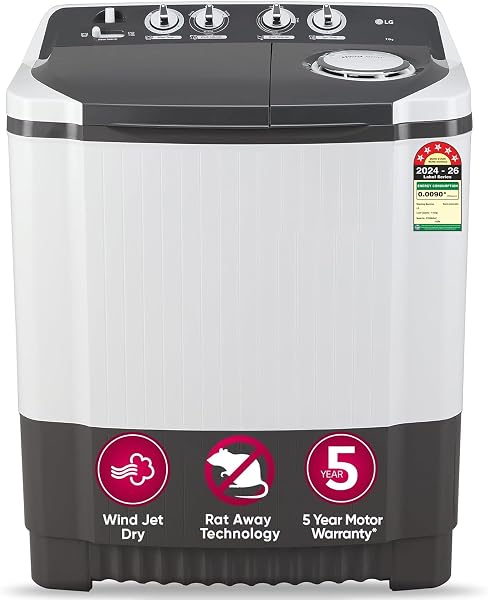
The semi-automatic is the machine your parents owned, and it still makes financial sense for a lot of Indian households. Two tubs, a spin drier rated at 700 RPM, and a plastic body that shrugs off hard water and rough handling. You manually move clothes from wash to spin, which is genuinely more work — but it also means no water inlet pressure requirement, no plumbing changes, and a wash that doesn't stall during a power cut.
This samsung 8 kg semi-automatic is the right pick if you're on a tight budget, live in a rented flat where you can't modify plumbing, or have a borewell/overhead tank setup with unpredictable water supply. The spin drier gets clothes to roughly 60–70% dry, which matters during monsoon when sun drying is a fantasy.
Pros: Lowest upfront cost, minimal maintenance, works without continuous water supply, no installation complexity.
Cons: Manual operation, higher water consumption, more floor space, no star rating, plastic build feels basic.
2. Samsung 8 kg Top Load 5-Star (WA80T4560BM1TL) — Best Value Overall
This is the model I'd recommend to most first-time fully-automatic buyers. The Digital Inverter motor runs without brushes, which means quieter operation, fewer failure points, and — crucially — the ability to run on lower voltage without tripping. Samsung backs the inverter motor with a 10-year warranty on top of 2 years comprehensive, and that's a meaningful differentiator in Indian conditions where voltage fluctuation quietly kills lesser machines.
The Diamond Drum's embossed pattern is not marketing fluff; the smaller, rounded holes genuinely reduce snagging on delicate fabrics like chiffon sarees and cotton kurtas. The Centre Jet does a decent job of dissolving detergent, though in very hard water you'll still want a water softener or a hard-water-specific detergent.
Pros: Strong 5-star energy rating, low running cost, 10-year motor warranty, ideal for 4–5 person families, no plumbing drama.
Cons: Top-load agitation is harsher on woollens than front-load, uses more water than a front-loader, rinse quality drops in extremely hard water.
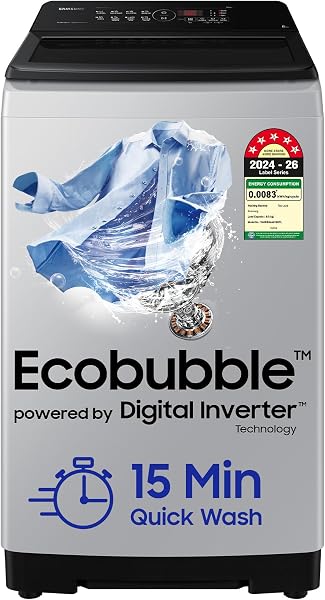
3. Samsung 8 kg Top Load with Ecobubble & Wi-Fi (WA80BG4686BRTL) — Best Smart Top Loader
Ecobubble is Samsung's genuinely useful party trick: it pre-dissolves detergent into a foam before it touches your clothes. The practical benefit in India is real — foam dissolves better in cold water, so you can wash at lower temperatures and still get stains out, which cuts electricity use and is gentler on colours. If your family washes a lot of coloured cottons and kurtas, the difference in fabric fade over two years is noticeable.
The Wi-Fi piece adds remote start, cycle completion alerts, and Samsung's SmartThings app diagnostics. It's nice-to-have rather than essential — but the app's troubleshooting has saved more than one user a service visit for what turned out to be a blocked filter.
Pros: Excellent stain removal at low temperatures, app-based diagnostics, great for coloured fabrics.
Cons: You pay a ₹4,000–5,000 premium over the non-Ecobubble top loader, and Wi-Fi adds no value if you don't use smart features.
4. Samsung 8 kg Front Load with Ecobubble (WW80T4040CE1TL) — Best Entry Front Loader
If your budget stretches to the high twenties, a front-loader changes the laundry experience entirely. A 1400 RPM spin extracts far more water than any top-loader, which in practice means clothes come out substantially drier — a blessing in humid coastal cities like Mumbai, Chennai and Kochi. Front-loaders also use roughly 40–50% less water, which adds up if you're on a metered municipal supply.
This samsung 8 kg front loader handles the essentials without the smart frills. It's the sweet spot if you want better wash quality and gentler fabric care but don't want to pay for AI features you'll never configure.
Pros: Superior water efficiency, gentler wash, faster drying thanks to 1400 RPM spin, stackable design saves floor space.
Cons: Needs consistent water pressure, may need a voltage stabiliser, longer cycle times, must use front-load (low-foam) detergent.
5. Samsung 8 kg Front Load with AI Control (WW80T504DAN1TL) — Best Premium Pick
The AI Control variant learns your wash habits and suggests the right cycle based on what you've been running recently, and it adds a Steam cycle that's genuinely effective on stubborn collar grime and allergy-related concerns. It also displays remaining time more accurately than most — a small thing until you've waited three hours for a "90-minute" cycle.
For a family spending north of ₹30,000, the extra ₹3,000–4,000 over the base front loader is defensible if you value convenience and steam sanitisation. If not, save the money.
6. Samsung 8 kg Washer-Dryer (WD80T554DBX1TL) — Best for Apartments Without Drying Space
The wash capacity is 8 kg; the dry capacity drops to 6 kg because a dryer drum needs more space per kilo of laundry. That asymmetry is worth understanding before you buy: a full 8 kg load must be split before you switch to drying. If you plan around it, this is a superb machine for Mumbai, Bengaluru high-rises and anyone whose "balcony" is really a 3x4 ft ledge.
The Air Wash feature uses heated air without water — genuinely handy for refreshing a blazer or removing smoke smell from clothes that don't need a full wash.
Pros: One machine does both jobs, saves balcony space, excellent during monsoon, air refresh is a nice bonus.
Cons: Dryer cycles are slow (90–180 minutes) and power-hungry, higher purchase price, more complex to service.
Key Factors to Consider Before Buying a Samsung 8 kg Machine
Loading type: top vs front vs semi-automatic
Top-load machines are cheaper, easier on the back (no bending), and more forgiving of interrupted water supply. Front-load machines clean better, use less water, and spin faster. Semi-automatics win on price and ruggedness. There is no universally "best" — match it to your plumbing, budget and household.
Star rating and real electricity cost
A 5-star samsung 8 kg machine uses roughly 0.008–0.010 units per kg per cycle compared to 0.012–0.014 for a 3-star. Over five years of daily use, the difference is roughly ₹4,000–6,000 in most Indian cities. Since Samsung's 8 kg lineup is now almost entirely 5-star, this is less of a differentiator than it was in 2019 — but always check, because lower-priced variants sometimes carry older 4-star stock.
Water hardness — the factor nobody mentions at the showroom
If your TDS is above 300 ppm, hard water minerals will deposit on the heating element and drum over 2–3 years, reducing efficiency and eventually killing the machine. Practical fixes: use a hard-water detergent, add a descaling powder (Samsung sells one; third-party options like Affresh work too) once a month, and avoid the hottest wash settings unless necessary.
Water pressure and plumbing
Front-loaders need a minimum inlet pressure of about 0.3–0.5 bar. If you live on the fourth floor of an old building with a weak overhead tank, a front-loader will keep beeping mid-cycle. Top-loaders are far more tolerant. Test your tap pressure before you commit.
Voltage stabiliser needs
Samsung front-loaders generally tolerate 100–280V fluctuations, but in areas with frequent brownouts or spikes, an external stabiliser (₹1,500–3,000) is cheap insurance for a ₹30,000 machine. Samsung's inverter-motor top-loaders are more tolerant and usually fine without one.
Warranty specifics
Samsung's standard terms in India are 2 years comprehensive + 10 years on the Digital Inverter motor (front load and top load). Semi-automatics get 2 years on the product and 5 years on the motor. Always confirm the warranty card accompanies the invoice — third-party sellers on marketplaces sometimes dispatch without it.
Pros and Cons: Samsung 8 kg Washing Machines Overall
What Samsung gets right
- Service network: Samsung's authorised service coverage in India is among the widest — a genuine advantage in Tier 2 and Tier 3 cities where other brands have thin coverage.
- Ecobubble technology: Effective cold-water washing that saves electricity and preserves fabric colour.
- Digital Inverter motor: Quiet, durable, backed by a 10-year warranty, and tolerant of Indian voltage conditions.
- Breadth of choice: Semi-automatic to washer-dryer, all in 8 kg, so you're not forced into a category by capacity.
- Strong resale and spare parts availability — useful if you relocate.
Where Samsung could be better
- Premium pricing: A comparable LG or Bosch 8 kg front loader often costs ₹2,000–4,000 less.
- Confusing model naming: Hard to tell variants apart without a spec table — the reason guides like this exist.
- Wi-Fi locked behind higher trims: You can't get a smart top-loader below ₹21,000.
- App ecosystem is inconsistent: SmartThings works well for diagnostics but the cycle-customisation options are limited compared to what the marketing suggests.
- Installation delays: During festival sale periods, Samsung's installation queue can stretch to 4–6 days in metros.
Where and When to Buy for the Best Price
Online vs offline
Amazon India and Flipkart typically list samsung 8 kg models 8–15% below brick-and-mortar MRP, and bank offers (HDFC, ICICI, SBI cards) knock off another ₹1,500–3,500 on a ₹25,000 machine. The trade-off is that installation scheduling is on you, and returns on large appliances are cumbersome.
Offline stores like Croma, Reliance Digital and Vijay Sales are worth visiting for two reasons: you can hear the machine run (quietness varies more than spec sheets admit), and store managers will often match online prices plus throw in free installation or an extended warranty. If you're buying a ₹30,000+ front-loader, negotiating in person is genuinely worth an hour of your time.
Best times of year to buy
- Amazon Great Indian Festival and Flipkart Big Billion Days (usually September–October): deepest discounts, up to 25–30% off MRP.
- Republic Day and End of Season sales (January): good on older model years being cleared.
- Amazon Prime Day / Flipkart Plus days (July): moderate discounts, usually 10–15%.
- March–April: pre-summer clearances; less advertised but often the quietest deals on last-gen stock.
Avoid buying in the two weeks immediately after a major sale ends — prices reset and stock of the best variants runs dry.
Practical buying
Affiliate Disclosure:
This post contains affiliate links. We may earn a commission when you purchase through our links, at no extra cost to you.
Share this: