Xiaomi Power Bank 4i 20,000mAh Review — Best 20000mAh Power Bank Under ₹3,000

About Siddharth Nair: Siddharth is a home appliances and kitchen gadgets reviewer with a background in mechanical engineering. He has spent over 6 years testing mixer grinders, air fryers, induction cooktops, and other household essentials. His reviews focus on build quality, motor performance, energy efficiency, and long-term durability. He believes the best gadget is one that makes daily life simpler.
How We Tested
Xiaomi Power Bank 4i 20,000mAh
Best Value ★ 4.2/5The Xiaomi Power Bank 4i 20K is the grown-up version of the Mi 3i - double the capacity, nearly double the speed.
- Capacity: 20000
- Output Ports: 1x USB-C, 2x USB-A
- Fast Charging: 33
- Weight: 440
- Input Type: USB-C: 33W PD
The Quick Verdict
The Xiaomi Power Bank 4i 20K is the grown-up version of the Mi 3i - double the capacity, nearly double the speed. At ₹2,099, it delivers 20,000mAh capacity with 33W fast charging - an impressive package for the Under ₹3,000 segment.
The Good
- Excellent value at ₹2,099 for the features offered
- 33W fast charging handles most devices adequately
- 20,000mAh provides 4x+ charges for most phones
- Reliable build quality for daily use
- Flight-safe design (under 100Wh)
The Bad
- Not the fastest charging option in the segment
- No digital display on most variants
- Multi-port charging reduces output speed
- Charging cable not always included
Who Should Buy?
| Buy If | Skip If |
|---|---|
| Heavy users, travelers, fast-charging enthusiasts | You need 65W+ laptop charging |
| You want reliable daily charging | Wireless charging is a must-have |
| Brand trust matters | You need ultra-compact size |
| You're on a budget | You want premium aluminum build |
Understanding the 20,000mAh Capacity
When you invest in a 20,000mAh power bank, you are essentially carrying a massive reservoir of backup energy. The headline figure of 20,000mAh is the raw capacity of the internal lithium polymer cells. Because power banks operate at a nominal 3.7V internal voltage, there is a conversion factor when this energy is stepped up to the standard 5V required by most USB devices. Realistically, you can expect around 13,000 to 14,000mAh of usable output capacity. Even after accounting for heat dissipation and cable conversion losses, this is a substantial amount of power.
For the average Indian smartphone user carrying a device with a 5,000mAh battery, the Xiaomi Power Bank 4i 20K provides 4x+ charges. This means you can go from a completely empty phone to roughly 80 to 85 per cent capacity four times over before the power bank itself needs to be plugged into the wall. For commuters who spend hours navigating traffic or travelling on the metro, students attending long college hours, or professionals on extended field assignments, this removes the constant anxiety of a depleted battery.
The 33W Fast Charging Experience
The standout feature of the Xiaomi Power Bank 4i 20K is its 33W fast charging capability. Historically, budget power banks in the Indian market maxed out at 18W. Xiaomi has pushed the envelope here, offering charging speeds that align with the demands of modernflagship and mid-range smartphones. If your smartphone supports a standard 33W charging protocol, this power bank will replenish your device at nearly the same speed as your wall charger.
Equally important is the input charging speed. A 20,000mAh battery can take an excruciatingly long time to refill if it only supports 10W or 18W input. With 33W input support, you can fully recharge the power bank itself in around seven to eight hours. We highly recommend using a compatible 33W wall charger to achieve these speeds. It is worth noting that a suitable charging cable is not always included in the box, which is a common corner-cutting measure in this price segment. Micro-USB to USB Type-C or a high-quality USB Type-C to USB Type-C cable is what you will need to maximise the potential of this device.
Design and Build Quality Analysis
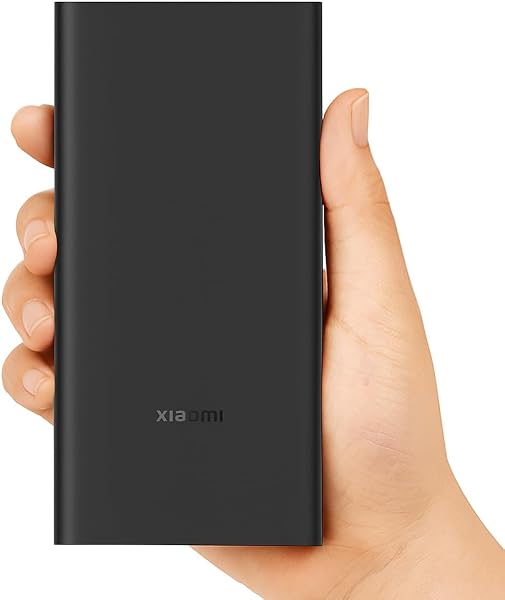
Visual appeal is a subjective area but Xiaomi has refined its design language with the Power Bank 4i series. The device abandons the stark, utilitarian look of older models in favour of a more contemporary, rounded-edge aesthetic that is comfortable to hold during prolonged use. The textured finish on the casing provides a reasonable grip, which is crucial for a device of this weight. This is not a power bank you would comfortably slip into a tight pair of trousers; it belongs in a backpack, a laptop bag, or a handbag.
Given the massive internal capacity, it is inevitable that the Xiaomi Power Bank 4i 20K carries a certain amount of heft. While it is not exceptionally heavy for its capacity class, it is noticeably denser than a standard smartphone. The materials are robust polycarbonate, which manages to survive the occasional bumps of daily commuting. While some users may desire a premium aluminum alloy build, achieving that at the ₹2,099 price point without compromising on the internal cell quality is practically impossible. The polycarbonate shell also helps keep the weight slightly lower compared to a metal equivalent.
Port Configuration and Multi-Device Charging
The power bank features multiple ports to accommodate various charging needs. Typically, this includes a combination of USB Type-C and standard USB Type-A outputs. The inclusion of a USB Type-C port that functions as both an input and an output port is a critical feature for modern tech users, as it allows you to carry a single cable for both your phone and the power bank itself.
When you are charging a single device, the 33W output is excellent. However, heavy users should be aware that multi-port charging reduces output speed. If you plug in two devices simultaneously in a bid to charge a phone and a pair of wireless earbuds at the same time, the total available 33W is shared between both ports. The prioritisation and power distribution algorithms are reasonably effective at ensuring both devices receive adequate power, but you will not achieve peak charging speeds on either device when both ports are actively drawing current.
Flight Safety and Travel Considerations
A crucial advantage highlighted by this power bank is its flight-safe design (under 100Wh). The regulations set by the Bureau of Civil Aviation Security (BCAS) in India, and international aviation bodies, prohibit lithium-ion batteries exceeding 100 Watt-hours in checked baggage and restrict those between 100Wh and 160Wh to carry-on baggage with prior airline approval, if permitted at all. A 20,000mAh battery with a nominal 3.7V internal configuration translates to exactly 74 Watt-hours (74Wh).
This means you can comfortably carry the Xiaomi Power Bank 4i 20K in your carry-on luggage without facing any issues at airport security. For frequent travellers, this flight-safe designation is often the deciding factor between a 20,000mAh unit and a larger 30,000mAh alternative, the latter of which usually breaches the 100Wh limit and is barred from flights altogether.
Common Use Cases for the Indian Consumer
In the context of the typical Indian consumer-tech landscape, there are several scenarios where this power bank proves invaluable:
- Long Commutes: For users navigating long daily commutes involving multimodal transport such as bus, auto-rickshaw, and metro, where charging points are virtually non-existent.
- Online Gaming: PUBG Mobile, BGMI, and Call of Duty Mobile are notorious for draining smartphone batteries rapidly. The 33W output allows you to game while the phone is plugged in, without the battery level plummeting.
- Power Outages: In regions where load shedding or frequent power cuts are a reality, a 20,000mAh power bank ensures your essential communication devices remain online throughout the night.
- Photography and Vlogging: Creators shooting long wedding sequences or outdoor vlogs can sustain their equipment throughout the day without needing a wall socket.
What to Look For When Buying a Power Bank Under ₹3,000
To truly understand whether the Xiaomi Power Bank 4i 20K is the right purchase, it helps to understand the broader landscape of power banks available under the ₹3,000 threshold. When evaluating alternatives in this category, consumers should prioritise the following parameters:
- Actual Capacity vs Rated Capacity: Always look for the rated capacity at standard 5V output to understand how much real-world power you are getting.
- Two-Way Fast Charging: Ensure the power bank supports fast charging on both the input (for refilling the power bank) and the output (for charging your devices). An 18W power bank is merely a baseline today; aim for 22.5W, 30W, or higher.
- Safety Protections: Look for integrated safeguards against over-voltage, under-voltage, short-circuit, and temperature fluctuations. Xiaomi generally includes a 12-layer chip protection system in this tier.
- Pass-Through Charging: The ability to simultaneously charge the power bank and a device plugged into it is a massive convenience during travel.
Bottom Line
The Xiaomi Power Bank 4i 20,000mAh is a solid choice in the Under ₹3,000 power bank segment. At ₹2,099, it offers reliable 20,000mAh capacity with 33W charging - a practical solution for everyday charging needs.
Rating: 4/5
Frequently Asked Questions
- Does the Xiaomi Power Bank 4i 20K support laptops?
No, this power bank is not designed for laptop charging. Most laptops require a 65W or higher output, whereas this device maxes out at 33W. It is strictly intended for smartphones, tablets, and small accessories. - Is there a wireless charging option available?
No, this specific model does not feature a wireless charging coil. If wireless charging is an absolute must-have for your smartphone or earbuds, you will need to look at alternative models or significantly increase your budget. - How do I check the remaining battery level?
The power bank features a standard row of four LED indicators. A quick button press displays the remaining power in 25 per cent increments. - Can I carry this on a domestic flight in India?
Yes. With a total energy capacity under 100Wh (calculated at 74Wh), it complies with BCAS guidelines for carrying lithium battery banks in your carry-on luggage.
Affiliate Disclosure:
This post contains affiliate links. We may earn a commission when you purchase through our links, at no extra cost to you.
Share this: