How to Choose Washing Machines in India: The Complete Buyer's Guide

About Rahul Verma: Rahul is a tech enthusiast and gadget reviewer with over 8 years of experience testing consumer electronics. He specializes in audio gear, smartwatches, and mobile accessories. When he is not testing products, you will find him exploring the latest in AI and smart home technology.

Walk into any electronics store in India today and you'll be staring at a wall of washing machines — 40-odd models from a dozen brands, each with a confusing mix of star ratings, drum sizes, spin speeds, and invented feature names like "Eco Bubble" and "Fuzzy Logic". Prices swing from ₹8,999 for a basic semi-automatic to ₹75,000 for a premium German-engineered front loader. And every salesperson will tell you their brand is the best.
The truth is that there is no single "best washing machine" in India — there's only the best machine for your household, water supply, family size, and budget. A 7 kg front loader that's perfect for a Bengaluru apartment with a balcony and treated borewell water would be a frustrating choice for a joint family in Jaipur dealing with 900 TDS hard water and erratic voltage.
This guide breaks down how to choose washing machines in India the way an experienced buyer would: understanding what each type actually does, calculating the capacity you genuinely need, decoding BEE star ratings into real rupees, and flagging the India-specific problems (hard water, monsoon drying, voltage dips) that brochures never mention. By the end, you'll know exactly which specifications matter and which are marketing noise.
Understanding Washing Machines: How They Actually Work
Before comparing models, it helps to understand that all washing machines clean clothes the same fundamental way — through a combination of mechanical agitation, detergent chemistry, water, and sometimes heat. What changes across machine types is how each of these four elements is delivered.
The three cleaning mechanisms
Agitation (top load semi-automatic and fully automatic): A central pulsator or agitator swirls clothes through the water. The friction between garments does the cleaning. It's effective but harder on fabric — you'll notice your cottons fade and thin faster over years.
Tumbling (front load): The drum rotates and lifts clothes to the top, then lets them drop. Clothes gently slap against each other and the drum surface. This uses far less water, far less detergent, and is measurably gentler — which is why front loaders are recommended for woollens, silk-blends, and expensive ethnic wear.
Soaking and stirring (semi-automatic wash tub): An impeller at the bottom of the wash tub moves clothes in a circular motion. You control the timing manually, which is why semi-automatics can handle pre-soaking better than most fully automatic machines.
Semi-automatic vs fully automatic: the real distinction
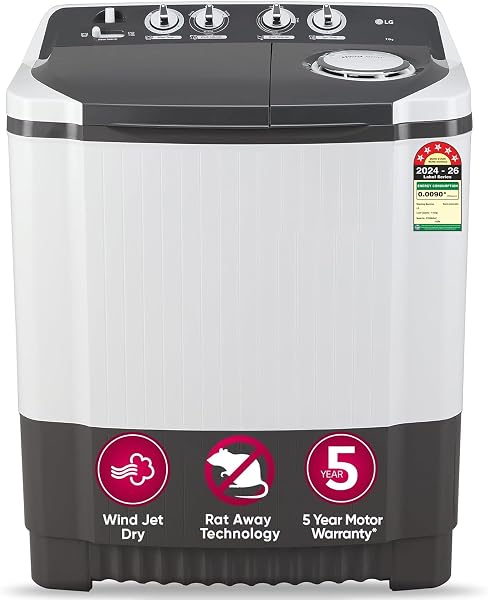
A semi-automatic machine has two tubs — one for washing, one for spin-drying — and you physically move clothes between them, fill water with a hose, and set the drain manually. It's labour-intensive but remarkably rugged, works on low voltage, tolerates hard water better, and costs a third of what a front loader does.
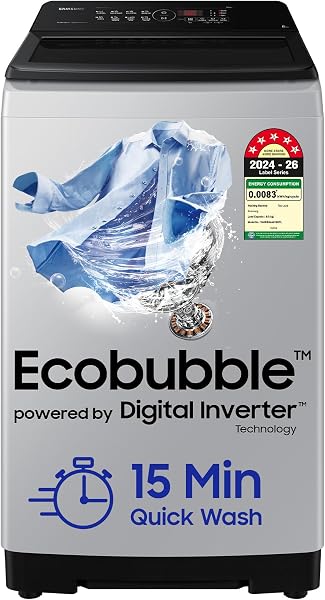
A fully automatic machine handles the entire cycle — fill, wash, rinse, drain, spin — from a single program selection. Within this category you have top load (lid opens upward) and front load (door on the front, horizontal drum). The convenience is real, but so is the dependence on consistent water pressure and stable electricity.
Why Choosing Carefully Matters More in India
Buying advice written for Western markets rarely addresses Indian conditions. Here's what actually affects your decision:
- Hard water is the norm, not the exception. Large parts of Delhi NCR, Chennai, Jaipur, Hyderabad, and Ahmedabad get water with TDS between 400 and 1,200 mg/L. Hard water reduces detergent lather, leaves white scale deposits on heating elements, and progressively dulls clothes. Front loaders are more sensitive to this than top loaders.
- Voltage fluctuation. Many Indian localities still see the supply dip to 170V or spike to 270V. Machines rated for 100–290V operation (common on inverter models) handle this far better than fixed-voltage machines.
- Monsoon and drying space. If you live in Mumbai, Kochi, or Kolkata, you already know that line-drying is unreliable from June to September. Spin speed and residual moisture matter enormously here — a machine that spins at 1,200 RPM leaves clothes noticeably drier than one spinning at 800 RPM.
- Water scarcity. In Chennai, Bengaluru, and parts of Gurugram, a washing machine that uses 120 litres per cycle is a genuine problem. Front loaders typically use 40–60% less water.
- Service network reality. A premium imported brand is worthless if the nearest authorised service centre is 90 km away. Always check pincode-level serviceability before buying.
Key Factors to Consider Before Buying a Washing Machine
1. Machine type — the decision that drives everything else
This is the single biggest fork in the road. Section below breaks it down fully, but the short version: semi-automatic for tight budgets and hard water; fully automatic top load for convenience at a mid price; front load for the best wash quality, water savings, and fabric care.
2. Capacity — calculate it properly, not optimistically
Capacity is quoted in kilograms of dry cotton. Most Indian families overestimate what they need, then under-load the machine, which wastes water and electricity. A useful rule of thumb:
| Family size | Recommended capacity | Notes |
|---|---|---|
| 1–2 people (bachelor / couple) | 6–6.5 kg | A 6 kg machine comfortably handles 3–4 shirts, 2 trousers, and innerwear per load |
| 3–4 people | 6.5–7.5 kg | The most common Indian household size; 7 kg is the sweet spot |
| 5 people or a family with young children | 7.5–9 kg | Children generate multiple outfit changes daily |
| Joint families (6+) or anyone washing quilts, razai, and curtains | 9–10 kg and above | Buying under 8 kg means a king-size quilt will never fit inside |
One caveat: a front loader's drum fills more compactly than a top loader's, so a 7 kg front load actually holds roughly similar real-world laundry as a 7.5–8 kg top load. If you're comparing across types, err on the slightly larger side for top load.
3. BEE star rating — read the actual number, not just the stars
Star ratings for washing machines have been mandatory in India since 2010. The label rates energy efficiency from 1 to 5 stars, but the genuinely useful figure is the annual energy consumption in kWh printed on the label, calculated on a standardised number of wash cycles. Two 5-star machines of the same capacity can still differ by 15% in annual consumption — so compare the kWh figure directly.
Also note that the label lists water consumption in litres per year. In water-stressed cities, this number should influence your decision as much as the energy figure.
4. Spin speed
Spin speed (RPM) determines how much water is extracted before drying. Front loaders typically run 1,000–1,400 RPM; top loaders 700–1,000 RPM. Higher is better for monsoon climates and for anyone who tumble-dries. Below 800 RPM, clothes come out noticeably damp — acceptable in dry Rajasthan, annoying in humid Kerala.
5. Drum and build quality
Stainless steel drums outlast plastic-coated ones and resist rust in humid coastal cities. Check the drum's surface finish — poorly finished drums snag delicate fabrics. For semi-automatics, look at the body material: powder-coated steel or fibreglass bodies resist rust far better than cheap painted metal, which matters in coastal Mumbai, Goa, and Chennai.
6. Motor type and warranty
Inverter (BLDC) motors are now standard on most mid-range and premium machines. They're quieter, more energy-efficient, and tolerate voltage fluctuation better. Brushless direct-drive motors (LG's Inverter Direct Drive, Bosch's EcoSilence Drive) eliminate the belt entirely — fewer parts to fail, less vibration. Most major brands offer 2–4 years comprehensive warranty plus 10–12 years on the motor; confirm this in writing, as it varies by model, not just brand.
7. Hard water tolerance
If your TDS is above 500 mg/L, either buy a machine with a built-in water softener (a few Samsung and Bosch models offer this) or install an inline softener at the inlet. Semi-automatics are the most forgiving. Front loaders with exposed heating elements are the most vulnerable — scale build-up is the number one cause of heating element failure in Indian front loaders.
8. Service network and brand presence
LG, Samsung, Whirlpool, Bosch, IFB, Haier, Godrej, and Voltas Beko all have reasonably deep service networks in Tier-1 and Tier-2 cities. Before buying, visit the brand's website and check service availability for your pincode. Also check how long the brand has sold that specific platform in India — a model launched six months ago may have parts that take three weeks to arrive.
Detailed Breakdown of Washing Machine Types
Semi-automatic top load (₹9,000 – ₹18,000)
Pros: Cheapest to buy and repair; works on low voltage and low water pressure; extremely hard-water tolerant; you control water usage by filling manually; can pre-soak for hours; spin dryer at 1,300–1,400 RPM leaves clothes quite dry; lasts 10–12 years with basic care.
Cons: Significant manual labour — you move clothes between tubs, fill water, and drain; more water consumption per wash; harsher on fabrics; takes up more floor space; aesthetics are industrial rather than premium.
Best for: Budget-conscious buyers, rented accommodation, areas with poor water pressure, families with a house help who does laundry, and anyone with very hard water.
Fully automatic top load (₹14,000 – ₹28,000)
Pros: Full automation at a mid price; no bending required, which matters for elderly users; easier to add clothes mid-cycle; generally faster cycles (40–60 minutes); tolerates moderate voltage fluctuation; fewer installation constraints.
Cons: Higher water consumption than front load; wash quality is a notch below front load; top-load machines tend to tangle long garments and dupattas; limited hot-water washing (most rely on a built-in heater only in premium models).
Best for: Nuclear families wanting convenience without front-load prices, elderly users, and households with inconsistent water pressure.
Front load (₹22,000 – ₹65,000)
Pros: Best cleaning performance per litre of water; uses 40–60% less water; gentlest on fabric — clothes genuinely last longer; higher spin speeds (up to 1,400 RPM) mean faster drying; built-in water heater enables hot washes that kill allergens and sanitise; stackable or under-counter installation saves space.
Cons: Highest purchase price and repair cost; longer cycle times (90–150 minutes for a full cotton cycle); requires steady water pressure and a 16A socket; needs low-suds detergent; hard water damages the heating element faster; you can't casually toss in a forgotten sock mid-cycle.
Best for: Apartments with space constraints, households with expensive or delicate clothing, water-scarce cities, and anyone prioritising long-term fabric life.
Washer-dryer combos (₹30,000 – ₹70,000)
A front loader with an added dryer function in the same drum. The catch: drying capacity is typically half the wash capacity, so a 8 kg washer-dryer dries only 4–5 kg. The condenser drying is also slow (2–3 hours) and energy-hungry. There's no lint filter in most models, so lint accumulates in the drum.
Verdict: Worth it only if you have absolutely no balcony or drying space, or live in a persistently humid climate. Otherwise, a separate front loader plus a good spin and a drying rack is more practical and cheaper to run.
Comparison Summary: Washing Machine Types in India
| Feature | Semi-automatic | Top load automatic | Front load |
|---|---|---|---|
| Typical price (₹) | 9,000 – 18,000 | 14,000 – 28,000 | 22,000 – 65,000 |
| Water per cycle (approx.) | 120 – 150 L | 90 – 120 L | 40 – 60 L |
| Electricity per cycle (approx.) | 0.4 – 0.6 units | 0.8 – 1.2 units | 0.7 – 1.1 units |
| Wash quality | Good | Good | Excellent |
| Fabric care | Harsh | Moderate | Gentle |
| Drying efficiency | Good (fast spin) | Moderate | Excellent |
| Hard water tolerance | High | Moderate | Low to moderate |
| Manual effort | High | None | None |
| Repair cost | Low | Moderate | High |
| Lifespan (typical) | 10 – 12 years | 8 – 10 years | 8 – 12 years |
Decoding Running Costs: Is That Extra Star Worth It?
Here's an illustrative calculation for a family running roughly 300 wash cycles a year at ₹8 per unit of electricity:
| Machine | Units per cycle | Annual units | Annual electricity cost |
|---|---|---|---|
| 6.5 kg semi-automatic |