150 W Dolby Digital Bluetooth Soundbar HW-T42E/XL: The Complete Buying Guide for Indian Homes

About Rahul Verma: Rahul is a tech enthusiast and gadget reviewer with over 8 years of experience testing consumer electronics. He specializes in audio gear, smartwatches, and mobile accessories. When he is not testing products, you will find him exploring the latest in AI and smart home technology.

If you have spent any time shopping for a soundbar in India recently, you have probably noticed how confusing the model names get. Take the 150 w dolby digital bluetooth soundbar hwt42exl — a mouthful of a name that describes the Samsung HW-T42E/XL, a 2.1-channel soundbar that has quietly become one of the most searched audio accessories in the sub-₹12,000 bracket. It promises 150 watts of output, Dolby Digital decoding, Bluetooth streaming and a wireless subwoofer, all in a package that fits under a 43-inch TV without dominating your living room.
But is it actually worth your money in 2025? And how does it stack up against the JBL, Sony and boAt options crowding the same shelf? This guide breaks down exactly what you get, what you don't, the realistic street prices on Amazon and Flipkart, the best times of year to buy, and — critically — whether the 150 w dolby digital bluetooth soundbar hwt42exl is the right fit for your room size and viewing habits. By the end, you should be able to make a confident decision without second-guessing yourself at checkout.
What Exactly Is the 150 W Dolby Digital Bluetooth Soundbar HW-T42E/XL?
Samsung's model naming is genuinely unhelpful, so let us decode it properly. The HW-T42E/XL is a 2.1-channel soundbar — meaning two channels (left and right) in the bar itself, plus one dedicated subwoofer — with a combined rated output of roughly 150 watts. The "XL" suffix in the model code typically indicates the India-specific retail SKU, which is why you will see the same product listed slightly differently across Amazon, Flipkart, Croma and Reliance Digital.
The three headline features in the product name all matter, but not equally:
- 150 W output: The bulk of this power goes to the subwoofer, which is normal for a 2.1 system. The bar itself handles mid and high frequencies, while the sub takes everything below roughly 100–150 Hz. In practice, 150 W is plenty for a bedroom or a mid-sized living room — not for a large open-plan hall.
- Dolby Digital: This is the standard 5.1 surround format used by virtually every OTT platform and DTH set-top box. On a 2.1 system, Dolby Digital decoding means the soundbar receives a proper digital bitstream and downmixes it intelligently, rather than just playing stereo. Dialogue clarity on Netflix and Prime Video is noticeably better because of this.
- Bluetooth: Wireless music playback from your phone, with the added convenience of not needing your TV switched on. This is the single most-used feature for most Indian buyers, and it is why the 150 w dolby digital bluetooth soundbar hwt42exl appeals beyond just movie watching.
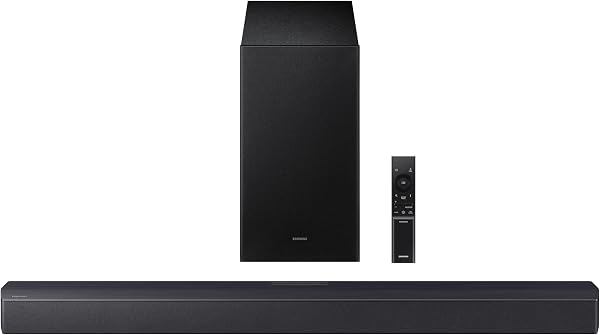
Physically, the HW-T42E/XL is a compact bar — roughly 90 cm wide — that pairs with a wireless subwoofer you can tuck beside the sofa or behind the TV unit. There is no rear speaker pair, so do not expect true surround; this is a punchy front-stage system designed to fix bad TV speakers, not to replace a home theatre.
Understanding 150 Watts: What the Number Actually Means
Soundbar wattage is one of the most misleading specifications in consumer audio, and Indian buyers get tripped up by it constantly. A 150 W rating on the 150 w dolby digital bluetooth soundbar hwt42exl is not comparable to a 150 W rating on a 5.1 system with five speakers and a sub — because that total is split across six drivers instead of three.
The practical reality: a genuine 150 W 2.1 system will comfortably fill a room of 150–200 sq ft at 60–70% volume without distortion. In an Indian context, that covers most 2BHK and 3BHK living rooms where the TV sits 8–10 feet from the sofa. Push it into a 20x20 ft hall at full volume and you will hear compression and bass muddiness — that is the physical limit of the driver size, regardless of what the wattage figure suggests.
Also be aware that many budget brands quote "peak" or "PMPO" wattage, which can be three to five times the real RMS figure. Samsung quotes a more honest number here, which is part of why the HW-T42E/XL feels underwhelming on paper next to a boAt bar claiming "500 W" — and yet usually sounds cleaner and louder in real use.
Key Factors to Consider Before Buying a Soundbar in India
1. Room Size and Seating Distance
For a bedroom or a compact living room under 150 sq ft, a 150 W 2.1 system is genuinely the sweet spot — more power just means you never turn the dial past 40%. For anything above 250 sq ft, or rooms with high ceilings and hard flooring, step up to a 300 W 2.1 or a 5.1 setup instead.
2. TV Compatibility and Ports
Check what your TV actually offers. If it has HDMI ARC, use it — one cable, one remote, and full Dolby Digital passthrough. If it only has optical out, that still carries Dolby Digital fine. If it is an older TV with only 3.5 mm or RCA output, you will be limited to stereo and lose much of the point of the Dolby Digital decoding on this bar.
3. Subwoofer Placement and Neighbour Problems
The wireless subwoofer is the main attraction of any 2.1 system, and also the main source of complaints from downstairs neighbours in apartment complexes. A downward-firing or rear-ported sub placed directly on a tiled floor transmits a lot of vibration. A thick mat or a small wooden plinth under the sub makes a surprising difference.
4. Streaming and Codec Support
Bluetooth on the 150 w dolby digital bluetooth soundbar hwt42exl is standard SBC/AAC, not aptX — which is fine for Spotify and YouTube but not audiophile-grade. There is no Wi-Fi, no AirPlay, no Chromecast built in. If multi-room streaming matters to you, this is the wrong product.
5. Warranty and Service Network
Samsung's service network in India is genuinely one of the widest, covering Tier-2 and Tier-3 cities reasonably well. For a product you intend to keep four or five years, that matters more than a 5 W spec difference against a rival.
Detailed Breakdown: What You Get With the HW-T42E/XL
Design and Build
The bar has a fabric-wrapped, low-profile design that sits neatly under most 43- to 55-inch TVs without blocking the IR receiver or the screen. Wall-mount brackets are included in the box, along with a remote, an optical cable and a power adapter for the sub. At roughly 2 kg for the bar and 5 kg for the sub, it is light enough to wall-mount on plasterboard with the right anchors — but if you are renting, consider a TV-unit placement instead.
Connectivity Options
- HDMI ARC — single-cable connection with CEC control, so your TV remote adjusts volume
- Optical (TOSLINK) — the most reliable fallback, carries Dolby Digital
- Bluetooth — for phone and tablet streaming
- USB — direct playback of MP3/WAV files from a pen drive, genuinely useful for offline music
There is no HDMI passthrough (no extra HDMI-in for a console), so if you have a PS5 or Xbox, you will connect the console directly to the TV and let the TV pass audio down to the bar via ARC. That works fine for Dolby Digital, but not for the uncompressed formats newer consoles can output.
Sound Modes and Real-World Performance
Sound modes typically include Standard, Music, Movie and Game. In everyday use, Movie mode gives the most satisfying result for OTT content — dialogue is lifted and the sub gets a modest boost. Standard is better for news and cricket, where an overactive subwoofer becomes annoying across a three-hour match. Game mode tightens the bass response to reduce lag on explosions, which helps in shooters.
Dialogue clarity is the standout strength. Indian living rooms are acoustically difficult (tiled floors, hard walls, no carpets), and TV speakers turn to mush at anything above 40% volume. The HW-T42E/XL keeps voices clean and centred, which is the single biggest upgrade most buyers notice on day one.
Comparison: HW-T42E/XL vs Popular Alternatives in India
| Model | Config / Output | Approx. Price (₹) | Best For |
|---|---|---|---|
| Samsung HW-T42E/XL | 2.1 / 150 W / Dolby Digital, Bluetooth, HDMI ARC, Optical, USB | ₹8,999 – ₹10,999 | Clean dialogue, Samsung TV owners, small-to-mid rooms |
| boAt Aavante Bar 1500 | 2.1 / ~120 W / Bluetooth, Optical, AUX, USB | ₹5,499 – ₹6,999 | Tightest budgets, bass-heavy Bollywood playback |
| JBL Cinema SB110 | 2.0 / 110 W / Bluetooth, Optical (no sub) | ₹7,999 – ₹9,499 | Buyers who cannot place a subwoofer |
| Samsung HW-B450 | 2.1 / 300 W / Dolby Digital, DTS, Bluetooth, HDMI ARC | ₹12,999 – ₹15,999 | Larger living rooms, more headroom |
| JBL Cinema SB190 | 2.1 / 380 W / Dolby Digital, Bluetooth, HDMI ARC | ₹14,999 – ₹17,999 | Bigger bass, punchier movies |
| Sony HT-S40R | 5.1 / 600 W / Dolby Digital, Bluetooth, rear speakers | ₹18,999 – ₹22,999 | True surround in a dedicated TV room |
Prices are indicative street prices on Amazon and Flipkart as of recent listings and fluctuate with sale events. Always verify the current price before ordering.
Pros and Cons of the 150 W Dolby Digital Bluetooth Soundbar HW-T42E/XL
What Works Well
- Excellent dialogue clarity — the biggest real-world benefit for OTT and news viewing in noisy Indian homes
- Genuine Dolby Digital decoding, not just a logo sticker; OTT audio is downmixed properly
- Reliable wireless subwoofer with a stable connection that does not drop out mid-movie
- Wide connectivity — HDMI ARC, optical, Bluetooth and USB cover almost every Indian TV setup
- Samsung service network and typically a 1-year warranty with good Tier-2 city coverage
- Compact footprint that suits 43- and 50-inch TVs in apartments
Where It Falls Short
- No Wi-Fi or smart features — no AirPlay, Chromecast or app-based control beyond the basic Samsung remote
- 150 W is modest for large halls; you will want the HW-B450 if your room exceeds ~200 sq ft
- No HDMI input, so consoles must route through the TV
- No Dolby Atmos — do not buy this expecting height effects
- Bass is controlled rather than dramatic; buyers used to boAt-style thump may find it polite
- Frequent price swings mean you can overpay by ₹2,000 if you buy at the wrong time
Buying Guide: Where and When to Buy in India
Where to Buy
Amazon India and Flipkart are the default choices, and both carry the HW-T42E/XL regularly. Amazon usually wins on delivery speed and returns; Flipkart often undercuts on price during Big Billion Days. For offline buyers who want to hear the unit first, Croma and Reliance Digital stock it in most metros, though expect to pay ₹1,000–₹2,000 more than online — you are paying for the demo and instant possession.
One important tip: check that the listing is sold by a Samsung-authorised seller. Grey-market units can appear on marketplace listings at tempting prices, and Samsung India will refuse warranty service on them. Look for the "Sold by Appario" or "Samsung India" tags on Amazon, and "Seller: SuperComNet" or similar authorised partners on Flipkart.
When to Buy
- Amazon Great Indian Festival (Sept–Oct) and Flipkart Big Billion Days — typically the deepest discounts, often ₹2,000–₹3,500 below MRP with bank offers stacked on top.
- Republic Day and Diwali sales — the second-best windows, with HDFC/ICICI card offers usually adding 10% instant discount.
- Prime Day (July) — good but rarely the lowest price of the year.
- Avoid December and June — post-sale lulls where prices sit at near-MRP.
Also watch for exchange offers on older soundbars or TVs, and check that the subwoofer is included in the listing — some marketplace sellers list the bar alone at a misleadingly low price.
Practical Usage Tips for Indian Homes
Set the Subwoofer Level Low First
Out of the box, most buyers crank the sub to maximum within the first hour. That is a mistake in tiled Indian living rooms, where bass reflects aggressively and turns dialogue muddy. Start at 40–50% sub level, then increase only if it feels thin after a week.
Use HDMI ARC Wherever Possible
Optical works, but HDMI ARC gives you CEC — meaning your existing TV remote controls the soundbar volume. In a household where family members switch on the TV, this eliminates the "the soundbar is on the wrong input" phone call entirely.
Manage the Power Cycle Properly
Indian power supply, especially in Tier-2 cities, sees frequent voltage dips. Plug the soundbar and sub into a surge protector rather than a direct wall socket — subwoofer power supplies are the first thing to fail in voltage spikes. During monsoon, unplug during long outages.
Position the Subwoofer Off the Floor
Placing the wireless sub on a 1–2 inch wooden plinth or a dense rubber mat reduces floor vibration transmitted to neighbours. Corner placement gives more boom; mid-wall placement gives cleaner, tighter bass. If you live in a flat, prefer the latter.
Use USB Playback During Internet Outages
A genuinely underrated feature in India — load a pen drive with MP3s and you have music during broadband or Wi-Fi outages, without relying on Bluetooth pairing every time.
Frequently Asked Questions
Is 150 W enough for a 12x15 ft living room?
Yes, comfortably. A room of that size is roughly 180 sq ft, and the 150 w dolby digital bluetooth soundbar hwt42exl will reach cinema-loud levels at around 65–75% volume. Beyond 250 sq ft, or in rooms with double-height ceilings, consider the 300 W Samsung HW-B450 instead.
Does the HW-T42E/XL have HDMI ARC?
Most retail listings for the India-specific /XL variant include HDMI ARC alongside optical, Bluetooth and USB. Because marketplace listings vary between regional SKUs, confirm the port list in the product images or specification table on the exact listing before you order — this is a five-second check that prevents a return.
Can I use it with a non-Samsung TV?
Absolutely. The bar works with any TV that has HDMI ARC, optical output, or even a 3.5 mm headphone jack. The Samsung-specific features (like the ability to use Samsung TV speakers alongside the bar wirelessly) are limited to Samsung TVs, but basic operation is brand-agnostic.
Does it support Dolby Atmos?
No. The 150 w dolby digital bluetooth soundbar hwt42exl decodes Dolby Digital and DTS, which covers the standard audio tracks on Netflix, Prime Video, Disney+ Hotstar and DTH. Atmos content will play, but downmixed to 2.1 without height effects. For Atmos you need a bar with up-firing drivers, typically above ₹30,000.
Can I connect my phone and stream music?
Yes, via Bluetooth, and it is genuinely the most-used feature for most buyers. Connection is stable up to about 8–9 metres with clear line of sight. Note that Bluetooth is SBC/AAC only — fine for Spotify and YouTube Music, not for lossless streaming.
How do I wall-mount it?
Wall-mount brackets are included in the box. Use masonry anchors for brick or concrete walls, and toggle anchors for plasterboard. Since the bar weighs roughly 2 kg, most TV-unit backboards can also support it — but check your TV's
Affiliate Disclosure:
This post contains affiliate links. We may earn a commission when you purchase through our links, at no extra cost to you.
Share this: