boAt EnergyShroom PB435 Review: Is This 20,000mAh Power Bank the Best Buy Under ₹3,000?

About Rahul Verma: Rahul is a tech enthusiast and gadget reviewer with over 8 years of experience testing consumer electronics. He specializes in audio gear, smartwatches, and mobile accessories. When he is not testing products, you will find him exploring the latest in AI and smart home technology.
If you have ever watched your phone drop to 8% battery while waiting at a railway station, sitting through a long client call, or halfway through a road trip on the Mumbai–Pune Expressway, you already know why a good power bank is not a luxury in India — it is basic survival equipment. The problem is that the sub-₹3,000 segment is crowded with no-name 20,000mAh bricks that claim 22.5W fast charging and deliver roughly half of it, and buyers get burned regularly.
The boAt EnergyShroom PB435 sits right in the middle of that chaos. It is boAt's attempt at a large-capacity, fast-charging power bank that looks better than the competition, is priced aggressively, and comes from a brand with an actual service network in India. In this detailed review, you will find a full specification breakdown of the boAt EnergyShroom PB435, realistic charge-cycle numbers (not marketing ones), a comparison against the Mi, Ambrane and realme alternatives, current price ranges on Amazon and Flipkart, and a clear recommendation on whether it deserves your money.
What is the boAt EnergyShroom PB435?
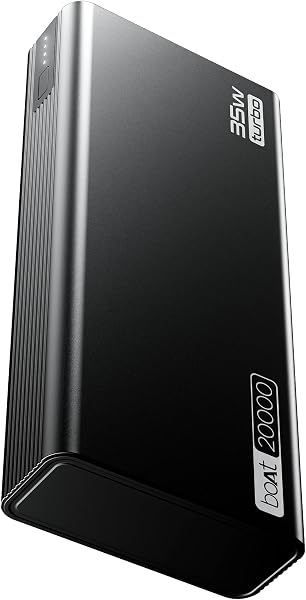
The boAt EnergyShroom PB435 is a 20,000mAh lithium-polymer power bank from boAt's EnergyShroom series, designed for people who need to keep a phone, and often a second device, alive through a full day and beyond. It supports up to 22.5W fast charging output, carries a USB-C port that works for both input and output, and includes dual USB-A outputs so two devices can charge simultaneously. It is BIS certified (mandatory in India under IS 16046), ships with a braided USB-C cable in the box, and is covered by a one-year brand warranty.
What separates the boAt EnergyShroom PB435 from a generic 20,000mAh unit is the combination of three things: the 22.5W ceiling (which actually engages on compatible fast-charging protocols rather than dropping to a flat 10W), a reasonably compact body for its capacity, and boAt's India-wide service presence. In the under-₹3,000 category, that third point matters more than most buyers realise until something goes wrong.
Why the boAt EnergyShroom PB435 Matters in the Under ₹3,000 Segment
Most power banks in this price band are built to a spec sheet, not to a use case. You will find 20,000mAh units at ₹1,299 that use low-grade cells, heat up noticeably after 20 minutes, and lose 25–30% of their rated capacity within a year of regular use. The boAt EnergyShroom PB435 does not revolutionise the category, but it does hit a sensible balance of capacity, charging speed, thermal behaviour and after-sales support that very few of its direct rivals manage at this price.
There is also the practical matter of portability. A 20,000mAh bank is inherently heavy — the boAt EnergyShroom PB435 weighs roughly 380–400 g — but it is slim enough to slide into a laptop sleeve or a backpack's tablet compartment without becoming a permanent brick. For students, delivery partners, sales professionals and frequent train travellers, that combination is exactly what the doctor ordered.
Key Factors to Consider Before Buying a Power Bank Under ₹3,000
Before you commit to any model, including the boAt EnergyShroom PB435, run through these checks. They are the difference between a power bank that serves you for three years and one that frustrates you in three months.
1. Real capacity versus usable capacity
A 20,000mAh power bank does not deliver 20,000mAh to your phone. Cell capacity is rated at 3.7V, while USB output is 5V, and there are conversion losses in between. Expect roughly 60–65% usable output — so around 12,000–13,000mAh at 5V. That translates to about 3 full charges of a 5,000mAh phone or 4–4.5 charges of a 4,500mAh handset. Any brand claiming otherwise is being creative with numbers.
2. Output wattage and supported protocols
22.5W only matters if your phone supports a protocol that talks to it. The boAt EnergyShroom PB435 handles PD 20W (great for iPhones and modern Android flagships), QC 18W, and the 22.5W SCP-style profile used by some Huawei/Honor devices. If you own a OnePlus with SuperVOOC or a realme with Dart Charge, understand that you will get standard PD/QC speeds, not the full 65W+ your phone is capable of.
3. Input charging speed
This is the most ignored spec and the most annoying in daily use. If a 20,000mAh bank only accepts 10W input, you are looking at 10–12 hours to refill it. The boAt EnergyShroom PB435 supports fast input via USB-C, bringing a full recharge down to roughly 6–7 hours with an 18W or 20W charger — provided you actually own one.
4. Port count and passthrough charging
Dual output is genuinely useful in an Indian household where one power bank is shared. Check whether the bank supports passthrough charging (charging the bank and a phone simultaneously) if you plan to leave it plugged in overnight.
5. BIS certification and cell quality
Since 2016, BIS certification is legally mandatory for power banks sold in India. Always check for the IS 16046 marking. The boAt EnergyShroom PB435 carries it, which is a meaningful safety baseline that unbranded sellers on marketplaces routinely bypass.
6. Warranty and service reach
boAt offers a one-year warranty and has a service network covering most major Indian cities, with pickup-and-drop support in many pin codes. Compare that with a ₹1,299 no-name bank that expects you to courier the unit to Delhi at your own cost.
boAt EnergyShroom PB435: Detailed Specifications and Feature Breakdown
Capacity and real-world charge cycles
The 20,000mAh cell array on the boAt EnergyShroom PB435 gives you a genuine two-day buffer for a single smartphone user, or one very solid day for someone carrying a phone plus earbuds plus a smartwatch. In practical terms, I would budget for about 3 full charges of an iPhone 15, 3.5 charges of a Samsung Galaxy S23, and roughly 3.5–4 charges of a Redmi Note-series phone. Remember that charging while the phone is in active use (navigation, hotspot, video calls) will cut these numbers by 20–30%.
Charging speed and protocol support
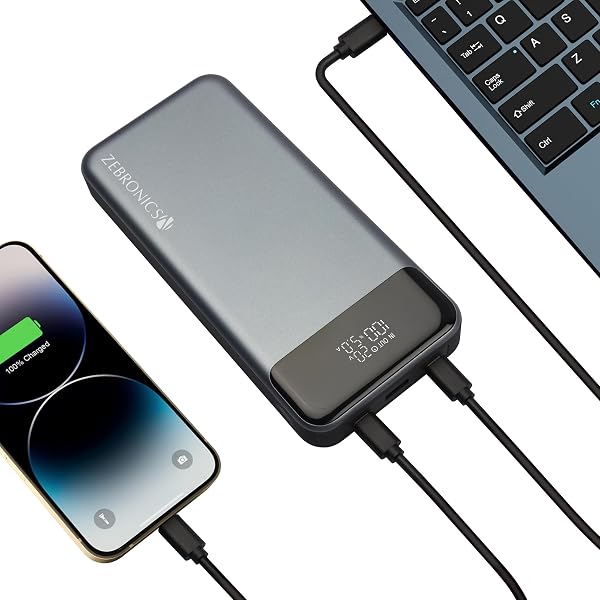
Output is capped at 22.5W across the USB-A ports, with USB-C delivering up to 20W PD. In real use, an iPhone 15 goes from 0 to about 55% in 30 minutes, and a mid-range Android with QC support hits similar figures. It is not blazing fast by 2024 standards — 65W and 100W banks exist — but at this price, 20–22.5W is the correct expectation and boAt delivers it without throttling aggressively.
Ports and compatibility
The boAt EnergyShroom PB435 gives you two USB-A outputs and one USB-C port that handles both input and output. A micro-USB input is also present on most variants for legacy cable compatibility, which is handy if you are upgrading from an older Android phone. It charges earbuds, smartwatches and fitness bands safely at low current, which many cheap power banks fail to regulate properly.
Design and build quality
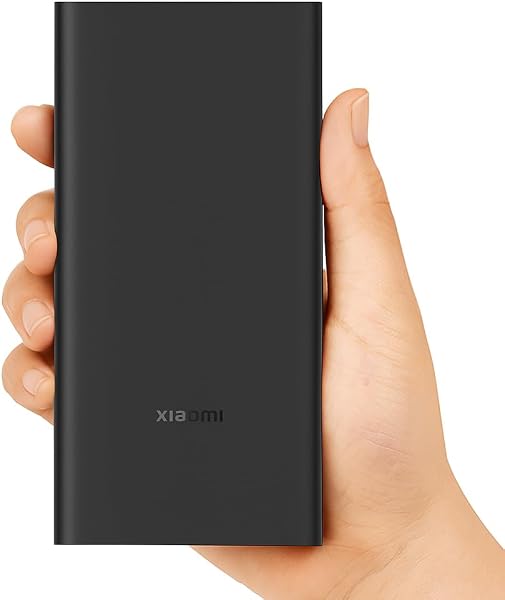
The EnergyShroom design language is distinct — a soft-touch matte finish with rounded edges and a compact footprint. It is not a fingerprint magnet and survives being tossed into a bag with keys. The LED battery indicator is a four-dot array rather than a percentage display, which is a small downgrade compared to some rivals that show exact battery percentage. For a device you check twice a day, four dots are adequate but not precise.
Safety and protection
The unit includes the standard multi-layer protection suite: over-charge, over-discharge, short circuit, over-current and temperature protection. In practice, the boAt EnergyShroom PB435 stays warm but not alarmingly hot during sustained 20W output — noticeably better behaved than several budget alternatives that become uncomfortable to hold.
boAt EnergyShroom PB435 vs Competitors: Quick Comparison
| Model | Capacity | Max Output | Ports | Approx. Street Price | Best For |
|---|---|---|---|---|---|
| boAt EnergyShroom PB435 | 20,000mAh | 22.5W | 2× USB-A, 1× USB-C (in/out), micro-USB in | ₹1,999 – ₹2,499 | Balanced pick with brand service support |
| Mi Power Bank 3i | 20,000mAh | 18W | 2× USB-A, micro-USB + USB-C | ₹2,199 – ₹2,499 | Buyers who prioritise reliability over speed |
| Ambrane Powerlit XL | 20,000mAh | 22.5W | 2× USB-A, USB-C, Lightning | ₹1,699 – ₹1,999 | Budget buyers wanting multi-port flexibility |
| realme Power Bank 3 | 20,000mAh | 22.5W | 2× USB-A, USB-C | ₹2,299 – ₹2,799 | realme/OPPO users wanting ecosystem match |
| Portronics Power 20K | 20,000mAh | 20W | 2× USB-A, USB-C + micro-USB | ₹1,599 – ₹1,899 | Value-focused buyers |
| Ambrane 27000mAh | 27,000mAh | 22.5W | 2× USB-A, USB-C | ₹2,799 – ₹2,999 | Long-distance travellers and trekkers |
Detailed Look at the Top Alternatives
Mi Power Bank 3i (₹2,199 – ₹2,499)
The closest genuine rival to the boAt EnergyShroom PB435 on trust. Mi's build quality is excellent, the two-way fast charging is dependable, and the service network is strong. The compromise is speed — 18W output and a slower input rate than the boAt. If your phone charges at 18W anyway, the Mi is a perfectly rational choice; if you want the extra 4.5W headroom, the boAt EnergyShroom PB435 is the better call.
Ambrane Powerlit XL (₹1,699 – ₹1,999)
This is the price-performance disruptor. Ambrane includes a Lightning input port, which is genuinely useful if you are an iPhone household with Lightning cables lying around. Output matches boAt at 22.5W. What you sacrifice is a bit of thermal polish and the boAt brand's resale and service comfort. If budget is the deciding factor, this is the one to shortlist alongside the boAt EnergyShroom PB435.
realme Power Bank 3 (₹2,299 – ₹2,799)
Well-built, with clean styling and solid 22.5W output. realme's fast-charging implementation is best optimised for realme and OPPO devices, so if you own one, this makes more sense than the boAt. For everyone else, there is no significant advantage to justify the higher typical price.
Ambrane 27000mAh (₹2,799 – ₹2,999)
If you regularly travel by train for 20+ hours or work in the field, the extra 7,000mAh is meaningful — roughly one additional full phone charge. The trade-off is weight, around 550g, which is genuinely noticeable in a backpack. For daily commuting, the boAt EnergyShroom PB435 is the more sensible carry.
Pros and Cons of the boAt EnergyShroom PB435
Pros
- Genuine 22.5W output with PD 20W support for iPhone and modern Android — no artificial throttling in normal use.
- Fast input charging via USB-C cuts refill time to about 6–7 hours with a 20W charger.
- BIS certified with a full protection suite; runs warm, not dangerously hot.
- Dual output lets you charge a phone and earbuds together without splitting speed awkwardly.
- One-year warranty with boAt's India service network and doorstep pickup in many cities.
- Clean, understated design that does not look like a generic grey brick.
- Frequently discounted below ₹2,000 during Amazon and Flipkart sale events — outstanding value at that point.
Cons
- No exact battery percentage display — only a four-dot LED indicator, so you never quite know if you have 60% or 35%.
- No built-in cable — you must carry your own, and the bundled cable is short.
- No wall charger in the box, so fast input charging requires you to already own an 18W/20W adapter.
- Weight of roughly 380–400g is normal for the capacity but still a commitment in a pocket.
- Does not support proprietary SuperVOOC or Dart Charge speeds, so OnePlus and realme users lose out on their phone's full potential.
Buying Guide: What to Look For in a Power Bank Under ₹3,000
Match the output to your phone, not to the marketing. If you own an iPhone 15 or a Pixel, 20W PD is your ceiling and the boAt EnergyShroom PB435 hits it exactly. If you own a OnePlus 12R with 100W SuperVOOC, no power bank under ₹3,000 will give you that speed — accept 18–22.5W and buy on capacity and reliability instead.
Check the input spec as carefully as the output. A 20,000mAh bank with 10W input is a weekend-long chore to refill. Look for USB-C input of at least 18W. The boAt EnergyShroom PB435 clears this comfortably.
Verify BIS certification and the warranty terms in writing. On Amazon and Flipkart, scroll to the "Safety and Warranty" section of the listing. If BIS certification or a brand warranty is not explicitly mentioned, walk away.
Buy from the brand store on the marketplace. Counterfeit power banks are a genuine problem on Indian marketplaces. Purchase the boAt EnergyShroom PB435 only from the official boAt store on Amazon or Flipkart, or from boAt's own website, Croma, Reliance Digital or Vijay Sales. Third-party sellers offering a brand-new 20,000mAh boAt unit at ₹999 are selling you a fire hazard.
Consider the total cost including a charger. If you do not own an 18W/20W adapter, factor in ₹500–₹800 for one. Without it, the fast
Affiliate Disclosure:
This post contains affiliate links. We may earn a commission when you purchase through our links, at no extra cost to you.
Share this: