Best Power Banks Under 3000 in India: Real Capacity, Fast Charging and Honest Picks

About Rahul Verma: Rahul is a tech enthusiast and gadget reviewer with over 8 years of experience testing consumer electronics. He specializes in audio gear, smartwatches, and mobile accessories. When he is not testing products, you will find him exploring the latest in AI and smart home technology.
A power bank is one of those purchases you make in a hurry and then live with for years — usually discovering its flaws at the worst possible moment, like a 6-hour train delay or a day of shoot photos at a wedding. The ₹2,000–₹3,000 price band is the sweet spot for most Indian buyers: it's where you get genuine 20,000mAh cells, real 18W–22.5W fast charging, and BIS-certified safety circuits, without paying the ₹5,000+ premium that flagship-brand models command.
But this segment is also the most crowded and the most misleading. Two power banks with identical "20,000mAh 22.5W" labels on Flipkart can behave completely differently once you actually use them — one charges your phone three times, the other barely manages two, and one runs hot by the third charge. In this guide we break down the best power banks under 3000 in India, explain what the spec sheets conveniently don't tell you, and help you match the right bank to your phone and your daily routine.
Note: prices in this segment fluctuate weekly during Amazon and Flipkart sales. All prices mentioned are indicative street prices at the time of writing.
Understanding Power Bank Capacity — Why 20,000mAh Isn't Really 20,000mAh
Before comparing models, you need one piece of knowledge that instantly makes you a smarter buyer. Power bank cells are rated at 3.7V (the nominal voltage of a lithium-ion cell), but your phone charges at 5V, 9V or higher over USB. Stepping 3.7V up to 5V involves conversion losses, and then the phone's own charging circuitry adds more. The practical result: a well-built 20,000mAh power bank delivers roughly 12,500–13,500mAh of usable output at 5V, not 20,000mAh.
Why it matters: a typical phone in this price range has a 5,000mAh battery. That means a 20,000mAh bank realistically gives you 2.5 to 3 full charges, not four. If a listing promises "4–5 full charges," it is either exaggerating or quoting a smaller test phone. Similarly, a 10,000mAh bank gives about 1.2–1.5 charges — enough for a day out, not a weekend trip.
Also check the watt-hour figure printed on the unit (Wh). Indian carriers and airlines regulate by Wh, not mAh:
- 10,000mAh ≈ 37Wh — well within limits
- 20,000mAh ≈ 74Wh — within the standard 100Wh cabin allowance
- 27,000mAh ≈ 100Wh — right at the edge; allowed but often scrutinised
Key Factors to Consider Before Buying a Power Bank Under ₹3000
1. Capacity vs. Portability — Be Honest About How You'll Use It
A 20,000mAh power bank weighs between 380g and 450g. That's roughly the weight of two phones. It disappears into a backpack but is genuinely annoying in a jeans pocket or a small sling bag. If your usage is commute-based top-ups, a 10,000mAh unit at ~210g is the smarter pick. If you travel by train, take overnight trips, or shoot video for a living, the 20,000mAh class is worth the bulk. Around ₹2,500–₹3,000 you can also find 27,000mAh models from value brands — but they cross 500g and are best treated as "one per bag" devices rather than everyday carry.
2. Fast Charging Standards — 18W, 22.5W, 25W or 33W?
Raw wattage numbers are meaningless if the protocols don't match your phone:
- USB-PD (Power Delivery) — the universal standard. Works with iPhones (20W+ needed for fast charge), most Samsung, Pixel, Nothing, and virtually all laptops that accept USB-C charging.
- QC 3.0/4+ (Qualcomm Quick Charge) — relevant for older Snapdragon phones and many Redmi/Poco/Mi models.
- PPS — a PD extension that Samsung uses for its 25W "Super Fast Charging." Without PPS, a Galaxy S-series phone will fall back to ~15W.
- VOOC / SuperVOOC / Dart / Warp — proprietary OnePlus, Realme, OPPO and Xiaomi standards. These only hit full speed with a matching brand power bank and a matching cable. A generic 22.5W bank will charge a OnePlus at a modest 10–15W.
Practical takeaway: if you own a OnePlus or Realme phone with 65W+ SuperVOOC/Dart charging, don't expect miracles from a third-party bank — budget for the brand's own model even if it costs ₹500 more.
3. Input Charging Speed — The Most Ignored Spec
A power bank with a slow input is a paperweight on busy days. A 20,000mAh unit with 18W input (9V/2A) refills in roughly 5–6 hours; a 10W input model takes 10–12 hours. If you're someone who plugs in overnight, this barely matters. If you're travelling and charging between trains, an 18W+ input is non-negotiable. Look specifically for USB-C input with PD support, because Micro-USB inputs cap out far lower.
4. Ports and Simultaneous Charging
Two output ports are standard in this price band and genuinely useful. Be aware of the fine print: total output is usually capped (often 5V/3A = 15W total) when both ports are in use, so simultaneous charging slows both devices. Also check whether the USB-C port is bi-directional (charge in and out) — rechargeable-by-C USB-C ports are far more convenient in 2025 than hunting for a Micro-USB cable.
5. BIS Certification and Safety Circuits
In India, power banks are covered under the BIS Compulsory Registration Scheme (IS 16046). A legitimate unit should show the BIS registration number (R-XXXXXXXX) on the box or the device. Beyond that, look for listed protections: over-charge, over-discharge, over-current, short circuit and temperature control. In a country where summer ambient temperatures in Delhi, Chennai and Ahmedabad routinely cross 40°C, thermal protection is not a marketing checkbox — it's what stops a swollen cell.
6. Build Quality and Warranty
Warranty varies wildly in this segment. Ambrane and Portronics typically offer 6–12 months, boAt offers 1 year, Xiaomi offers 6 months on most power banks, and Anker backs its units with up to 18 months. A textured plastic shell with rounded edges survives daily bag life better than a glossy one, which scuffs and shows fingerprints within weeks.
Best Power Banks Under 3000 in India — Top Picks Compared
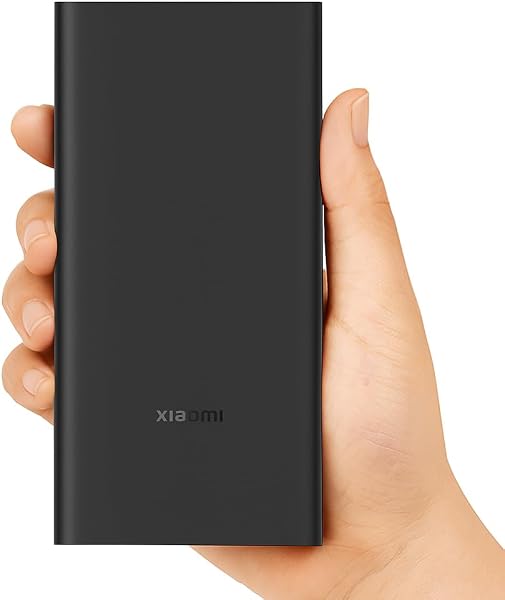
1. Mi Power Bank 3i 20,000mAh (18W) — Best Overall
The default recommendation for most Indian buyers, and for good reason. The 3i delivers a genuine 18W output over USB-C PD and QC 3.0, has two output ports plus a bi-directional USB-C port, and uses a textured two-tone shell that resists scratches far better than its price suggests. Xiaomi's cell quality has been consistently reliable across generations, and the 18W input means a full refill in about 6 hours with a decent charger.
Real-world performance: a 5,000mAh phone at 18W goes from near-empty to full in roughly 1 hour 40 minutes, and the bank delivers close to three full charges before shutting off. It does get noticeably warm during sustained 18W output, but stays within safe limits.
Pros: Reliable cell quality, true 18W two-way PD, wide service network, excellent resale of trust, works with almost every phone.
Cons: Only 18W output (slower than rivals at 22.5W), 6-month warranty is short, no PPS for Samsung 25W fast charging. Approx. ₹1,999–₹2,499.
2. Ambrane 20,000mAh 22.5W — Best Value
Ambrane has quietly become one of the strongest value players in the Indian market, and its 22.5W 20,000mAh models undercut Xiaomi and Realme by a comfortable margin. You get 22.5W PD + QC output, a digital LED percentage display on several variants (far more informative than four blinking dots), and three output ports.
The trade-off is cell consistency. Ambrane units generally work well, but the finish feels more plasticky than Xiaomi's and the brand's after-sales network, while present, is thinner than Xiaomi's. Buy from Amazon or Flipkart's official seller pages rather than third-party listings, since counterfeit Ambrane boxes do circulate.
Pros: Highest wattage per rupee, percentage display on select models, triple-port output, 1-year warranty on many variants.
Cons: Build feels less premium, output efficiency varies slightly between units, ambient heat buildup on long charges. Approx. ₹1,599–₹1,999.
3. Realme 20,000mAh Power Bank 2 (18W) — Best for Realme/OPPO Users
If you're already in the Realme ecosystem, this is the most coherent pick. It offers 18W two-way fast charging with 18W PD and QC 3.0 support, a clean design with a 13-layer circuit protection setup, and — importantly — better synergy with Realme phones' charging behaviour than a generic third-party bank.
It doesn't hit SuperVOOC speeds on Realme's 65W phones (for that you'd need the Dart model, which sits above this price band in 20,000mAh form), but it will charge them at a solid, consistent rate. The 18W output is competitive without being class-leading.
Pros: Well-built, clean design, reliable QC/PD support, good thermal behaviour, Realme/OPPO service centres in most cities.
Cons: 18W output trails 22.5W rivals, no percentage display, average cable bundled. Approx. ₹1,899–₹2,299.
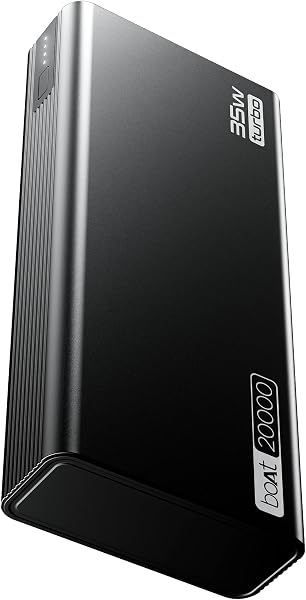
4. boAt EnergyShroom PB400 20,000mAh 22.5W — Best Design and Everyday Feel
boAt's power bank line has become a genuine competitor rather than a branding exercise. The PB400 delivers 22.5W PD + QC output, dual output plus bi-directional USB-C, and a soft-touch finish that simply feels better in hand than most rivals at this price. The 1-year warranty is also the most generous in the sub-₹2,500 bracket.
Its weakness is transparency: boAt's listings quote "up to 5 charges" in optimistic language, and the casing, while pleasant, picks up smudges quickly. Performance is solid — expect about three full charges on a 5,000mAh phone with stable 22.5W output on PD devices.
Pros: Best-in-class finish, genuine 22.5W output, 1-year warranty, strong brand support.
Cons: Marketing claims overstate charge counts, glossy surfaces show fingerprints, no display. Approx. ₹2,199–₹2,599.
5. Anker PowerCore Select 20,000mAh 20W — Best Build Quality
Anker costs more per mAh than anything else on this list, and it's worth explaining why. The company's PowerIQ technology negotiates the highest safe charging rate for the connected device rather than just shouting a wattage number, and Anker's failure rates are among the lowest in the industry. The 18-month warranty is the best in this segment.
If your priority is "buy once, forget about it," this is the pick. If your priority is maximum wattage or features per rupee, it isn't. Output caps at 20W, and the design is deliberately plain.
Pros: Outstanding reliability, intelligent charging negotiation, 18-month warranty, excellent safety circuitry.
Cons: Priciest here at ~₹2,799–₹2,999, 20W ceiling, plain design, frequently out of stock.
6. Samsung 10,000mAh 25W Power Bank — Best for Galaxy Users
If you own a Galaxy S-series or a recent Galaxy A-series phone, the 25W first-party bank is the only sub-₹3,000 option that reliably hits Samsung's Super Fast Charging speed, because it supports the PPS protocol Samsung uses. It's compact (~220g), USB-C only, and predictably well built.
The trade-off is capacity and versatility: 10,000mAh means roughly 1.3 charges for a Galaxy S24 Ultra, and there's no USB-A port for legacy cables or accessories. Buy it as a phone accessory, not as a family power bank.
Pros: True 25W PPS charging for Samsung, compact and light, excellent thermal management.
Cons: Low capacity, USB-C only, expensive per mAh. Approx. ₹2,499–₹2,999.
Quick Comparison Table
| Model | Capacity | Max Output | Ports | Weight | Approx. Price | Best For |
|---|---|---|---|---|---|---|
| Mi Power Bank 3i | 20,000mAh | 18W | 2× USB-A, 1× USB-C (in/out) | ~434g | ₹1,999–₹2,499 | All-rounder for most buyers |
| Ambrane 20,000mAh 22.5W | 20,000mAh | 22.5W | 2× USB-A, 1× USB-C | ~410g | ₹1,599–₹1,999 | Best value, tight budgets |
| Realme Power Bank 2 | 20,000mAh | 18W | 2× USB-A, 1× USB-C | ~430g | ₹1,899–₹2,299 | Realme/OPPO users |
| boAt EnergyShroom PB400 | 20,000mAh | 22.5W | 2× USB-A, 1× USB-C | ~420g | ₹2,199–₹2,599 | Design + 1-year warranty |
| Anker PowerCore Select | 20,000mAh | 20W | 2× USB-A, 1× USB-C | ~465g | ₹2,799–₹2,999 | Long-term reliability |
| Samsung 25W Power Bank | 10,000mAh | 25W | 1× USB-C only | ~220g | ₹2,499–₹2,999 | Samsung Galaxy owners |
Which Power Bank Should You Buy? Match It to Your Use Case
If you want one bank for the whole family
Go with the Mi Power Bank 3i 20,000mAh. Two USB-A ports plus USB-C means you can top up a phone, earbuds and a fitness band simultaneously (though all three will charge slower). Xiaomi's service network covers even tier-
Our Top Picks
This post contains affiliate links. We may earn a commission when you purchase through our links, at no extra cost to you.
Xiaomi Power Bank 4i 20,000mAh
- Capacity: 20000
- Output Ports: 1x USB-C, 2x USB-A
- Fast Charging: 33
- Weight: 440
- Input Type: USB-C: 33W PD

URBN 27000mAh Power Bank
- Capacity: 27000
- Output Ports: 2x USB-A + 1x USB-C
- Charging Case: 22.5
- Weight: 540
- Input Type: USB-C: 22.5W PD

Mi Boost Pro 30000mAh
- Capacity: 30000mAh
- Battery Type: Lithium Polymer
- Output Ports: 2x USB-A, 1x USB Type-C
- Output Power: 18W Max
- Input Port: USB Type-C

Ambrane 25W Qi2.2 Magsafe Wireless 20000mAh Powerbank, 35W Wired Charging, Fastest Qi2.2 Technology - Now Charge 40% in 30 mins...
- Battery Capacity: 20000
- Power Source: Corded Electric
- Number of Ports: 4
- Is Product Cordless: No
- Portable: Yes
Share this: