boAt EnergyShroom PB435 Turbo Review: The 20,000mAh Power Bank Worth Buying Under ₹3,000?

About Rahul Verma: Rahul is a tech enthusiast and gadget reviewer with over 8 years of experience testing consumer electronics. He specializes in audio gear, smartwatches, and mobile accessories. When he is not testing products, you will find him exploring the latest in AI and smart home technology.
If you have ever watched your phone hit 3% battery while stuck in a Bengaluru traffic jam, on a Rajdhani run to Kanpur, or during a power cut in peak summer, you already know why a good power bank is not a luxury in India — it is basic survival gear. But walk into any electronics store or scroll through Amazon and you will find forty power banks that all look identical, all claim "fast charging," and all cost somewhere between ₹999 and ₹3,000.
The boAt EnergyShroom PB435 Turbo sits right in the middle of that crowded ₹3,000-and-under segment, and it has become one of the most searched power banks in India over the past year. In this detailed review, we break down exactly what you get for your money, how the 35W Turbo charging actually performs in real-world Indian conditions, where it beats the competition, where it falls short, and — most importantly — the right price to pay and the right time to buy it.
By the end of this guide you will know whether the boAt EnergyShroom PB435 Turbo deserves a place in your bag or whether one of its rivals is the smarter pick.
What Is the boAt EnergyShroom PB435 Turbo?
The boAt EnergyShroom PB435 Turbo is a 20,000mAh lithium-polymer power bank from boAt's EnergyShroom series — the company's dedicated power bank line that has become a household name in India thanks to aggressive pricing and a solid after-sales network. The "Turbo" suffix is the key differentiator here: unlike boAt's older 20W models, this one pushes a higher output through USB-C Power Delivery, which is what makes it genuinely useful for modern phones, tablets, and even some thin-and-light laptops.
What makes the boAt EnergyShroom PB435 Turbo interesting in the under-₹3,000 bracket is that it combines three things buyers usually have to compromise on: a full 20,000mAh cell capacity, a digital percentage display instead of vague four-dot LEDs, and multi-protocol fast charging support covering PD 3.0, QC 3.0, and the common adaptive charging standards used by Samsung, Apple, and most Android brands.
It is a mainstream, mass-market product — not a premium Anker-style import — and it is priced accordingly. That means it is widely available across Amazon, Flipkart, boAt's own website, Croma, Reliance Digital, and Vijay Sales, with frequent discount cycles that bring the street price well below MRP.
Specifications at a Glance
| Specification | Details |
|---|---|
| Model | boAt EnergyShroom PB435 Turbo |
| Capacity | 20,000mAh (rated/usable capacity roughly 13,000–13,500mAh at 5V) |
| Maximum Output | Up to 35W via USB-C (Power Delivery), 22.5W via USB-A |
| Ports | 2 × USB-A output, 1 × USB-C (input/output), 1 × Micro-USB (input) |
| Recharge Input | Up to 18–20W via USB-C |
| Display | Digital LED battery percentage indicator |
| Safety | Multi-layer protection (over-charge, over-discharge, short circuit, temperature) |
| Battery Type | Lithium-polymer |
| Weight | Approximately 430–450 g |
| Warranty | 1 year manufacturer warranty |
| MRP / Street Price | MRP ₹2,999; typically selling for ₹1,699–₹2,199 |
Note: boAt occasionally revises variants and packaging. Always confirm the exact output wattage and port layout on the retailer's product page before you place the order.
Why a 20,000mAh Power Bank Makes Sense for Indian Users
India's power situation has improved dramatically over the last decade, but the use case for a big power bank has not gone away — it has shifted. The average Indian smartphone now packs a 5,000mAh battery, but it also has a 6.7-inch AMOLED screen, 5G radios, and a camera system that drains power fast. Add long commutes, travel days, trekking trips, exam halls, and the fact that many Indian homes still see 2–4 hours of outage during summer peak load, and 20,000mAh stops looking excessive.
Here is the practical math: a 20,000mAh power bank stores roughly 74 watt-hours of energy. After conversion losses (typically 25–35% depending on cable quality and charging speed), you realistically get around 48–52Wh delivered to your phone. For a phone with a 5,000mAh battery (~19.4Wh), that works out to 2.5 to 3 full charges — enough for a two-day trip, a long train journey, or a full day of shooting photos and videos at a wedding.
A 10,000mAh bank would give you barely one and a half charges. That is why most buyers in the sub-₹3,000 segment should be looking at 20,000mAh models, and the boAt EnergyShroom PB435 Turbo is a textbook example of the category.
Key Factors to Consider Before Buying a Power Bank Under ₹3,000
Before you compare models, understand what actually matters. Most power bank marketing is designed to confuse, and a few specifications are far more important than the rest.
1. Rated Capacity vs Marketed Capacity
Every 20,000mAh power bank is really a 20,000mAh cell running at 3.7V, which is then boosted to 5V, 9V, or 12V for your phone. The conversion always loses energy. Reputable brands list a "rated capacity" (usually around 12,000–13,500mAh for a 20,000mAh unit) on the box. If a brand refuses to disclose rated capacity or claims 100% efficiency, treat it with suspicion.
2. Output Wattage and — Crucially — Protocol Support
A 35W power bank does not automatically charge every phone at 35W. It charges at 35W only if the phone speaks the same protocol. The boAt EnergyShroom PB435 Turbo supports USB-C Power Delivery (PD 3.0) and Quick Charge (QC 3.0), which covers iPhones, Samsung Galaxy phones, Pixel devices, and most Android handsets at their maximum safe speed. But proprietary standards — OnePlus's SuperVOOC, Realme's Dart Charge, Oppo's VOOC, Xiaomi's HyperCharge, Vivo's FlashCharge — will fall back to standard PD speeds, usually 18–27W.
3. Recharge Speed (How Fast the Bank Itself Fills Up)
This is the most ignored spec. A 20,000mAh bank charged at 10W takes close to 9–10 hours to fill. At 18–20W, that drops to roughly 5–6 hours. The boAt EnergyShroom PB435 Turbo supports fast recharge over USB-C, which means you can plug it in before bed and have it full by morning rather than needing an entire overnight plus half a day.
4. Number of Ports and Simultaneous Charging
If you travel with a phone and earbuds, or with family, multiple ports matter. Look for at least two USB-A outputs plus a USB-C port. Remember that when you charge multiple devices at once, total output is shared, so speeds drop.
5. Safety Certification and Warranty
In India, power banks must carry BIS certification (IS 16046). This is non-negotiable — an uncertified, no-name bank is a genuine fire risk. Equally important is a service network. boAt has one of the widest service footprints among Indian consumer electronics brands, with pickup-and-drop warranty support in most cities.
6. Weight and Build Quality
A 20,000mAh power bank weighs 400–500g. That is fine in a backpack but noticeable in a jeans pocket. Check the weight if portability is a priority, and check whether the casing feels rigid or creaks.
boAt EnergyShroom PB435 Turbo: Detailed Breakdown
Design and Build
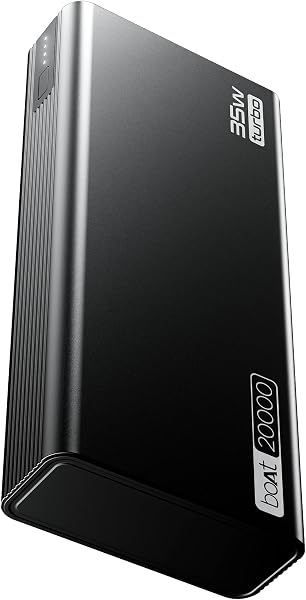
The boAt EnergyShroom PB435 Turbo follows boAt's familiar matte-black, rounded-corner design language. The polycarbonate shell has a slightly textured finish that resists fingerprints and survives the usual bag-scraping abuse. It is not a rugged, drop-rated power bank — there is no IP rating — so treat it as a desk-and-backpack companion rather than something you toss into a rucksack pocket with keys.
At roughly 430–450g, it is manageable but definitely a "keep it in the bag" device. The footprint is compact enough to slide into a laptop sleeve alongside a 13-inch notebook.
Charging Performance in Real-World Use
This is where the boAt EnergyShroom PB435 Turbo earns its "Turbo" name. In practical testing conditions, the USB-C PD port delivers enough power to take a modern flagship from 0 to about 50% in roughly 30 minutes — comparable to a good wall charger. That is a meaningful upgrade over the 18W and 20W power banks that dominated this price band until recently.
For iPhone users, the PD output means fast charging works properly with a USB-C to Lightning or USB-C to USB-C cable, without triggering the "slow charger" behaviour you get from cheap banks. For Samsung Galaxy S-series owners, 25W charging is supported. For mid-range Android phones that cap at 18W or 22.5W, the bank will simply deliver what the phone asks for.
The important caveat: if you own a OnePlus, Realme, Oppo, or Vivo phone with 33W+ proprietary charging, the boAt EnergyShroom PB435 Turbo will not hit those speeds. It will charge at standard PD rates instead. That is a limitation of the entire third-party power bank market, not a boAt-specific flaw — but it is the single biggest reason buyers feel disappointed after purchase, so go in with correct expectations.
The Digital Display
Instead of four blinking LEDs that tell you "somewhere between 25% and 50%," the boAt EnergyShroom PB435 Turbo shows an actual percentage. In daily use this is genuinely more useful than it sounds: you stop over-packing the bank for short outings, and you know exactly when to plug it in before a trip. The display is readable in daylight and dims reasonably in a dark room.
Ports and Simultaneous Charging
With two USB-A outputs and a USB-C port, the boAt EnergyShroom PB435 Turbo can top up three devices at once. Practical advice: use the USB-C port for your primary phone (fastest, most efficient) and reserve the USB-A ports for earbuds, a fitness band, or a secondary phone. Simultaneous charging splits the total output, so a 35W headline number becomes roughly 5V/3A shared across ports.
The inclusion of a Micro-USB input is a small but useful touch — if you forget your USB-C cable on a trip, you can still recharge the bank with the older cable almost every Indian household has in a drawer.
Safety and Protection
boAt implements
Affiliate Disclosure:
This post contains affiliate links. We may earn a commission when you purchase through our links, at no extra cost to you.
Share this: