boAt EnergyShroom PB500 Review: The Smartest Power Bank Buy Under ₹3,000?

About Rahul Verma: Rahul is a tech enthusiast and gadget reviewer with over 8 years of experience testing consumer electronics. He specializes in audio gear, smartwatches, and mobile accessories. When he is not testing products, you will find him exploring the latest in AI and smart home technology.
If you have ever watched your phone hit 8% battery while you are still 40 minutes away from home — stuck in traffic on the Western Express Highway, waiting on a platform at New Delhi Railway Station, or sitting through a power cut in peak summer — you already know why a reliable power bank is not a luxury in India. It is basic survival gear.
The problem is that the sub-₹3,000 power bank market is crowded with options that look identical on paper and disappoint in real life. Cells that claim 10,000mAh but deliver barely one charge. "Fast charging" labels that never actually trigger on your phone. Plastic shells that crack within six months.
That is exactly where the boAt EnergyShroom PB500 enters the conversation. boAt has built a strong reputation in India for value-for-money audio gear, and the EnergyShroom series is its push into the crowded but lucrative power bank space. In this detailed buying guide, we break down what the boAt EnergyShroom PB500 actually delivers, how it compares with alternatives from Mi, Ambrane, realme and Anker, what the current street prices look like on Amazon and Flipkart, and — most importantly — whether it deserves your ₹1,500 or whether you should look elsewhere.
By the end of this article, you will know the exact specs that matter, the traps to avoid, and the right time of year to buy so you do not overpay by ₹500 for the same product.
What Is the boAt EnergyShroom PB500?
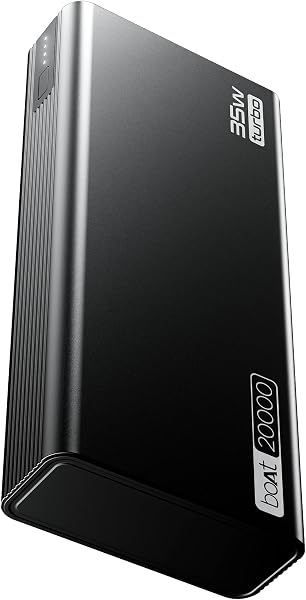
The boAt EnergyShroom PB500 is a 10,000mAh lithium-polymer power bank designed for everyday carry. It sits in the middle of boAt's EnergyShroom lineup — above the entry-level models and below the higher-capacity 20,000mAh variants — making it the model most buyers actually end up purchasing.
What defines it is the combination of a genuinely pocketable form factor with 22.5W fast-charging output. That wattage number matters in India specifically, because a large share of popular phones sold here — Redmi, Poco, realme, Samsung's M-series, iQOO — are tuned to draw somewhere between 18W and 33W. A power bank that caps out at 10W or 12W will technically charge your phone, but it will feel painfully slow, especially when you are charging while using GPS navigation or streaming video.
boAt positions this model as a daily-use companion rather than a travel-heavy workhorse. It is the power bank you throw into a backpack, a handbag, or a bike's storage compartment and forget about until you need it. For a student commuting to college, a salesperson on the road all day, or anyone who relies on their phone for UPI payments and OTPs, that is a sensible design brief.
boAt EnergyShroom PB500 specifications at a glance
Here is the spec sheet based on boAt's official listing and retail product pages. Do verify the latest figures on the Amazon or Flipkart product page before ordering, since brands occasionally revise variants.
| Specification | Details |
|---|---|
| Model | boAt EnergyShroom PB500 |
| Battery capacity | 10,000mAh (approx. 37Wh) |
| Cell type | Lithium-polymer |
| Max output | 22.5W (USB-A + USB-C output) |
| Fast-charging support | USB Power Delivery (PD) and Quick Charge (QC) compatible |
| Input | USB-C, supports fast recharge (approx. 3.5–4 hours with an 18W+ adapter) |
| Ports | USB-C (input/output) + USB-A output; simultaneous dual-device charging |
| Safety | Multi-layer protection against overcharge, over-discharge, short circuit and overheating; BIS certified |
| Indicators | LED battery-level indicator |
| Weight | Approx. 220–230 g |
| Warranty | 1 year (register on boAt's website for hassle-free claims) |
| Indicative price | MRP ₹2,499; typical selling price ₹1,299–₹1,799 |
Why the boAt EnergyShroom PB500 Suits Indian Buyers
1. Fast charging that actually matches mid-range phones
The single biggest reason to consider the boAt EnergyShroom PB500 is that 22.5W output ceiling. Most sub-₹1,500 power banks in India still ship with 10W or 12W output, which means a phone with a 5,000mAh battery takes nearly three hours to charge from a power bank. With a 22.5W-capable bank, a compatible phone can go from 20% to 70% in roughly 45–50 minutes. That difference is what turns a power bank from an overnight chore into something you genuinely use during the day.
Do keep one caveat in mind: proprietary fast-charging standards like SuperVOOC (OnePlus/realme), Warp Charge, or Xiaomi's 33W+ turbo charging are licensed technologies. Power banks from brands like boAt support standard PD and QC, which means your OnePlus or realme phone will fall back to a slower but still perfectly usable charging speed — usually around 15–18W. If you own a phone with a proprietary charger, temper your expectations accordingly.
2. A form factor that fits in a jeans pocket
At roughly 220 g and a slim profile, the boAt EnergyShroom PB500 is one of the more genuinely portable options in its capacity class. Compare it to any 20,000mAh power bank, which typically weighs 400–450 g and feels like carrying a second phone plus a brick. For daily commuters using Mumbai locals, Delhi Metro, or Bengaluru's office-cab routine, that weight difference is the difference between carrying it every day and leaving it at home.
3. Safety certification and after-sales support
This is often overlooked in online reviews, but it matters enormously. boAt products carry BIS certification, which is mandatory for power banks sold in India. More importantly, boAt has a genuine service network and an established warranty process — something you cannot say for the dozens of unbranded power banks flooding marketplaces at ₹799. When a power bank fails, and eventually it will, having a brand that responds to emails is worth the extra couple of hundred rupees.
Key Factors to Consider Before Buying Any Power Bank Under ₹3,000
Before you commit to the boAt EnergyShroom PB500 or any alternative, here are the factors that separate a good purchase from a regretful one.
Rated capacity vs usable capacity
A "10,000mAh" power bank never delivers 10,000mAh to your phone. The cells store energy at 3.7V, but the USB port outputs at 5V (or 9V during fast charging), and the conversion process loses energy as heat. Real-world efficiency is typically 60–70%. Practically, expect the boAt EnergyShroom PB500 to give you about 6,000–6,500mAh of usable charge — roughly 1.2 to 1.4 full charges for a phone with a 5,000mAh battery. Be sceptical of any listing that promises "3 full charges" from a 10,000mAh pack.
Output wattage and protocol support
Look for at least 20W output and explicit mention of USB Power Delivery or Quick Charge. A power bank without protocol support defaults to 5V/2A (10W) regardless of its claimed wattage. Always check the fine print on the port, not just the marketing headline.
Input charging speed
This is the most ignored spec. A power bank that takes 8 hours to recharge is effectively useless for anyone travelling. The boAt EnergyShroom PB500 supports fast input via USB-C, refilling in roughly 3.5–4 hours with a decent 18W or 20W adapter. If you plan to carry it on a multi-day trip, input speed matters as much as output.
Build quality and heat management
Indian summers are brutal on lithium cells. A power bank left on a car dashboard in May can hit 60°C internally. Look for metal or well-ventilated polycarbonate housings, and avoid ultra-cheap units that lack temperature sensors. Multi-layer protection circuits are not marketing fluff — they are the difference between a warm power bank and a swollen one.
Warranty and brand accountability
Insist on a minimum one-year warranty and a brand with an India-registered presence. boAt, Mi, realme, Ambrane, Anker and pTron all qualify. Random sellers on marketplaces with names you cannot pronounce do not.
boAt EnergyShroom PB500: Detailed Breakdown
Design and in-hand feel
The boAt EnergyShroom PB500 follows boAt's characteristic design language — clean lines, a slightly textured matte finish, and subdued colour options that do not scream for attention. The matte body resists fingerprints far better than the glossy plastic used on cheaper power banks, and it does not turn into a slippery bar of soap after a few weeks of use.
The LED battery indicator sits on the top face and shows charge level in discrete steps. It is not a full percentage readout, but it gives you enough information to decide whether to top up before leaving home. The single-button design is intuitive — press once to check charge, and the ports begin output automatically when a device is plugged in.
Charging performance in real-world use
In everyday scenarios, the boAt EnergyShroom PB500 behaves exactly as its spec sheet suggests. Charging a mid-range Android phone with a 5,000mAh battery from 15% to full takes roughly 90–100 minutes with a compatible cable and phone. Charging an iPhone with a USB-C to Lightning cable gets you the benefit of PD fast charging, taking an iPhone from 20% to 50% in around 30 minutes.
Dual-device charging works, but the 22.5W output is shared between the two ports when both are in use. If you plug in a phone and earbuds simultaneously, expect both to charge at reduced speed. This is normal behaviour across every power bank in this price bracket and not a defect.
What's in the box
boAt ships the power bank with a short USB-C charging cable and the standard documentation, including the warranty card. The bundled cable is functional but basic — it will handle standard charging fine, though if you want to hit the full 22.5W you should use a good-quality 3A-rated cable. Many buyers pair the boAt EnergyShroom PB500 with a separate braided USB-C to USB-C cable rated for 60W, which costs ₹200–₹300 and dramatically improves the experience.
Pros and cons of the boAt EnergyShroom PB500
What works well:
- 22.5W output with PD and QC support — fast enough for most Indian mid-range phones
- Lightweight (around 220 g) and genuinely pocketable
- BIS certified with proper multi-layer protection circuitry
- USB-C input makes recharging quick — roughly 3.5 to 4 hours
- One-year warranty backed by a brand with a real service presence in India
- Aggressive pricing, especially during Amazon and Flipkart sale events
Where it falls short:
- No full digital percentage display — only stepped LED indicators
- Does not support proprietary fast charging like SuperVOOC or Warp Charge
- Bundled cable is basic; a better cable is an extra cost
- 10,000mAh means roughly one full charge for a modern phone — not enough for multi-day trips
- No wireless charging, which some buyers now expect
Alternatives Worth Comparing Under ₹3,000
The boAt EnergyShroom PB500 is a strong contender, but it is not the only sensible purchase at
Affiliate Disclosure:
This post contains affiliate links. We may earn a commission when you purchase through our links, at no extra cost to you.
Share this: