
Costar 2in1 Espresso Machine for Capsules & Coffee Powder: The Complete 2025 Buying Guide for Indian Homes

About Rahul Verma: Rahul is a tech enthusiast and gadget reviewer with over 8 years of experience testing consumer electronics. He specializes in audio gear, smartwatches, and mobile accessories. When he is not testing products, you will find him exploring the latest in AI and smart home technology.

A decent cappuccino in a Bengaluru or Delhi café now costs ₹220–₹280. Multiply that by two cups a day and you're looking at over ₹15,000 a month on coffee alone. That's exactly why a growing number of Indian households are looking at the costar 2in1 espresso machine for capsules coffee powder — a machine that promises café-style espresso at home while letting you switch between convenient capsules on busy mornings and freshly ground coffee on lazy Sundays.
In this guide, we break down what this dual-format machine actually does, who it suits, what it realistically costs in India, how it stacks up against single-format rivals, and where to buy it for the best price. We also cover the practical stuff most reviews skip — capsule costs per cup, using South Indian coffee powder, hard-water descaling, and voltage fluctuations in Indian apartments.
Understanding the Costar 2in1 Espresso Machine for Capsules & Coffee Powder
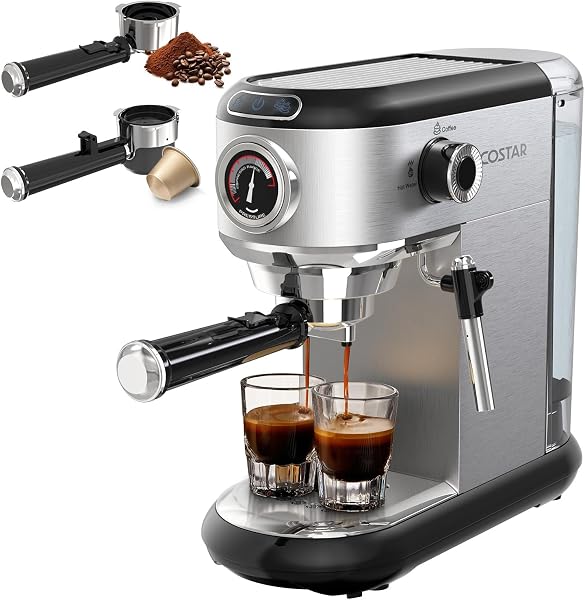
The term "2-in-1" gets thrown around loosely in appliance marketing, so let's be precise about what it means here. This machine has two distinct brewing paths built into one body:
- A capsule chamber — you drop in a single-serve coffee capsule, close the lever, and press a button. No measuring, no tamping, no mess.
- A ground coffee portafilter — you fill the included basket with coffee powder, tamp it lightly, lock it in, and pull a conventional espresso shot.
Both paths feed into the same brewing head and heating system, so you're not buying two appliances — you're buying one that adapts to how you drink coffee that day. Costar is one of the newer value-focused appliance brands selling largely through e-commerce platforms in India, and this dual-format model has become one of its more visible listings in the sub-₹10,000 espresso segment.
How the brewing actually works
Like most home espresso machines in this price band, the Costar unit uses a vibration pump (typically rated around 15–20 bar, though the pressure at the group head settles closer to 9 bar during extraction) paired with a thermoblock heating element. Cold water is drawn from the tank, flash-heated as it passes through the block, and forced through the coffee bed. A thermoblock heats up in roughly 30–45 seconds, which is far quicker than the old boiler-style machines that needed 5–10 minutes of warm-up.
One thing worth flagging: the "bar" number on the box is a marketing figure. A 20-bar pump on a ₹6,000 machine does not extract better than a well-tuned 15-bar pump on a ₹20,000 machine. What matters more is temperature stability and whether the basket is pressurised. Most budget machines, including this one, use a pressurised (dual-wall) basket, which is actually a good thing for beginners — it generates crema even with mediocre grind consistency.
Why a Dual-Format Machine Makes Sense for Indian Households
Most Indian homes don't have one coffee drinker — they have a mixed crowd. One person wants a quick Americano before a 9 AM call. Another prefers filter-style decoction coffee. A third is experimenting with single-origin beans from Chikmagalur. A machine that only accepts capsules locks you into one ecosystem; a machine that only accepts powder demands effort every single time.
The costar 2in1 espresso machine for capsules coffee powder sits right in the middle. It gives you the low-effort morning option and the low-cost-per-cup option without forcing a choice at purchase time. For a family of three or four, or for a household that entertains often, that flexibility is genuinely useful rather than just a spec-sheet flourish.
The running-cost argument
Capsules are undeniably convenient, but the economics are stark once you do the math over a year. A branded capsule costs roughly ₹28–₹45 per cup in India, while a good espresso grind from a roaster like Blue Tokai, Third Wave or Flying Squirrel works out to ₹13–₹18 per double shot. Over 300 cups a year, that difference is ₹4,500–₹8,000 — enough to fund a second machine's worth of coffee. The dual-format design means you can use capsules on weekdays and powder on weekends, or gradually shift to powder as you get comfortable with tamping and dosing.
Key Factors to Consider Before You Buy
1. Capsule compatibility — check this first
This is the single most important thing to verify before ordering. "Capsule compatible" is not a universal standard. Some machines take Nespresso-style capsules, others take Dolce Gusto pods, and a few take proprietary pods that are only sold by the brand itself. Before you buy, check whether the listing specifies compatibility with Nespresso-original or third-party Nespresso-compatible capsules — the latter are what you'll actually find cheaply on Amazon and Flipkart. If the listing is vague about capsule standards, treat that as a red flag.
2. Pump pressure and extraction consistency
Look for 15 bar or above, but don't obsess over it. More useful is to read reviews that mention crema quality and whether shots come out bitter or sour. If multiple reviewers say shots taste burnt, that usually points to an overheated thermoblock; if they say shots are watery, it's usually an underpowered pump or a poorly sealed portafilter.
3. Heat-up time and temperature control
Thermoblock machines heat in under a minute, which matters on rushed mornings. What they lack is precise PID temperature control — so you'll want to preheat the cup and run a blank shot before brewing to stabilise temperature. Budget about 60 seconds of preheating for noticeably better espresso.
4. Water tank capacity and counter footprint
Indian kitchen counters are precious. A machine with a 1–1.5 litre removable tank will make 8–12 espressos before a refill, which is adequate for a family. Confirm the tank is removable and top-fill accessible — refilling a fixed tank by the cup is genuinely irritating.
5. Milk frothing
Most machines at this price include a manual steam wand or a panarello-style frothing attachment. A manual wand gives better microfoam but takes practice; a panarello is foolproof but produces foamier, less integrated milk. If lattes and cappuccinos are your daily drink, prioritise a machine with a proper steam wand.
6. Warranty, service and voltage tolerance
Check whether the warranty is brand-backed or seller-backed. On marketplaces, "1-year seller warranty" often means you ship the machine to a third-party service centre at your own cost. Also ask about voltage tolerance — Indian apartment complexes and tier-2 towns still see voltage swings, and a ₹1,200 voltage stabiliser is cheap insurance for a machine with a heating element and a pump.
Costar 2in1 Espresso Machine — Detailed Breakdown
Design and build quality
The machine follows the compact, boxy silhouette familiar from entry-level De'Longhi and Agaro models — matte plastic body, stainless-steel-look accents, a drip tray that's removable for taller mugs. It's built to a price, and you should expect that: the plastic feels functional rather than premium, and the portafilter is lighter than the commercial-style ones on machines costing three times as much. For a first espresso machine, though, it's perfectly serviceable, and the compact footprint suits small kitchens and bachelor apartments.
Brewing performance
On the capsule path, performance is largely determined by the capsule itself — the machine just needs consistent pressure and temperature, and it delivers that. Expect a 30–40 ml espresso in about 25–30 seconds, with a thin but visible crema. On the ground coffee path, results depend heavily on your grind. Use a fine espresso grind (not the coarse powder used for South Indian filter coffee) and tamp with moderate, even pressure — roughly the weight of pressing down on a kitchen scale until it reads 10–15 kg.
Where budget machines typically stumble is back-to-back brewing. Pull two doubles in quick succession and the second may run cooler. If you're making four coffees at once, pull shots, then froth milk, and reheat slightly.
Ease of use
This is where the dual-format design earns its keep. The capsule path requires literally two actions: insert, press. The ground coffee path is a five-step routine — dose, level, tamp, lock, brew — that becomes muscle memory within a week. There are no menus, no app pairing, no digital display to fail. For households where one person is tech-averse and another wants control, this simplicity is a feature, not a compromise.
Cleaning and maintenance
Daily: empty the drip tray, rinse the portafilter basket, and run a blank shot after the last coffee of the day. Weekly: wipe the steam wand immediately after use (dried milk is the single biggest cause of clogged wands), and remove and rinse the capsule chamber. Monthly: backflush if a blind basket is included, and descale every 2–3 months if your tap water is hard. In most Indian cities — especially Delhi NCR, Chennai and parts of Gujarat — water hardness is high enough that descaling every 6–8 weeks is realistic.
What's typically in the box
Standard retail packaging for this class of machine includes the espresso unit, a ground coffee portafilter and basket, a measuring scoop with tamper, a capsule holder insert, and the user manual. Some listings bundle a few starter capsules; treat those as a sample, not a supply. Verify the exact inclusions on the product page, since sellers occasionally vary bundles.
Pricing in India and where to buy
Realistic street price for the costar 2in1 espresso machine for capsules coffee powder sits in the ₹5,499–₹7,999 band, against an MRP that sellers typically list between ₹12,000 and ₹15,000. Prices swing meaningfully during sale events, so the same machine can differ by ₹1,500–₹2,000 between a normal week and a festive sale.
Where to buy:
- Amazon India — widest seller choice, easiest returns, and the best place to read verified-purchase reviews before committing.
- Flipkart — frequently matches or beats Amazon during Big Billion Days; check bank card offers.
- Croma / Reliance Digital — useful if you want to physically inspect the build and confirm service support in your city, though online prices are usually lower.
- Brand's own website — sometimes offers extended warranty or free capsule bundles.
Pros and cons
What works well
- Genuine dual-format flexibility at a price where most rivals offer only one
- Compact footprint suited to Indian kitchen counters
- Fast thermoblock heat-up — coffee in under a minute
- Low entry cost vs. buying separate capsule and espresso machines
- Simple, button-driven operation with nothing to configure
What to be aware of
- Plastic-heavy build; not a "buy once, keep for a decade" machine
- Capsule compatibility must be verified — not every pod format works
- No PID temperature control, so shot consistency varies
- Pressurised basket limits the ceiling on grind quality experimentation
- Service network is thinner than established brands like Philips or De'Longhi
Comparison: Costar 2in1 vs. Other Options in India
| Model | Format | Typical Price (₹) | Best for |
|---|---|---|---|
| Costar 2in1 Espresso Machine | Capsules + ground coffee | 5,499 – 7,999 | Mixed households; first-time buyers who want both formats |
| Agaro Regal / 19-bar espresso | Ground coffee only | 6,000 – 9,000 | Buyers who only drink freshly ground espresso |
| Inalsa / Wonderchef entry espresso | Ground coffee only | 4,500 – 7,000 | Tight budgets, occasional use |
| Morphy Richards New Europa | Ground coffee only | 9,000 – 12,000 | Better build and steam wand at a mid price |
| Nespresso Essenza Mini | Capsules only | 12,000 – 16,000 | Maximum convenience, single-format households |
| De'Longhi Dedica EC685 | Ground coffee + ESE pods | 17,000 – 23,000 | Long-term quality, slim footprint, strong service network |
Prices are indicative for 2025 and fluctuate with seller offers, bank discounts and sale events.
Budget-Wise Recommendations
Under ₹5,000 — entry-level, ground only
At this price you won't get reliable dual-format brewing. Expect a basic 15-bar machine with a pressurised basket. It will make an acceptable espresso and a passable frothy milk, but the build will feel light and the steam wand will be weak. Buy only if you're testing whether home espresso is a habit you'll sustain.
₹5,000–₹9,000 — the sweet spot for dual-format
This is where the costar 2in1 espresso machine for capsules coffee powder makes the most sense. You get both brewing paths, a usable steam wand, and a footprint that fits a small kitchen — without paying Nespresso or De'Longhi money. If your household has both capsule fans and powder purists, this is the most efficient spend in the category.
₹10,000–₹20,000 — better materials, better shots
At this level, machines like the Morphy Richards New Europa or De'Longhi Dedica offer metal bodies, better temperature stability and stronger service networks. You lose the capsule path in most cases (the Dedica accepts ESE pods, which are hard to find in India), but shot quality improves noticeably.
Above ₹20,000 — semi-automatic territory
Once you cross ₹20,000, you're better off buying a machine with a non-pressurised basket and a decent burr grinder separately. A ₹20,000 espresso machine paired with a ₹8,000 grinder will outperform any ₹28,000 all-in-one. This is the path to take if you've been brewing for a year and want to explore single-origin beans.
Capsules vs Coffee Powder: Cost Per Cup in India
| Input | Cost per cup (₹) | Effort |
|---|---|---|
| Third-party Nespresso-compatible capsule | 28 – 45 | Minimal |
| Branded original capsule | 40 – 60 | Minimal |
| Ground coffee (₹450–₹600 per 250 g, 9 g dose) | 13 – 20 | Moderate — dose, tamp, clean |
| Milk, sugar, electricity (approx.)
Affiliate Disclosure: This post contains affiliate links. We may earn a commission when you purchase through our links, at no extra cost to you. Share this: Related ProductsView all in Coffee Makers →
Best Seller
VANTRO Espresso Coffee Machine | 20 Bar Professional Pressure | 1500W | Stainless Steel Housing | Touch Control Panel | Adjustable Temper...
4.6 / 5

Best Seller
De’Longhi Dedica Style Espresso Machine with Milk Frother, 15-Bar Pressure, Original Italian Barista Style Coffee Maker for Home, Make ...
4.5 / 5

Best Seller
De’Longhi Dedica Duo Cold Brew Espresso Machine with Milk Frother, 15 Bar Pressure, Original Italian Barista Style Coffee Maker, Make E...
4.5 / 5
Popular
COSTAR 2-in-1 Espresso Machine for Capsules & Coffee Powder, 20 Bar Capsules Coffee Machine, Coffee Maker Machine for Home W/NS Original ...
4.5 / 5
Related Posts
review
Rossmann Espresso Coffee Maker: Honest Review, Real Prices and the Smart Way to Buy in IndiaRossmann Espresso Coffee Maker: Honest Review, Real Prices and the Smart Way to Buy in India If you...
Nov 23, 2026
review
Domestica Brewcraft 35 Bar Espresso Coffee Maker Machine for Home — A Complete India Buying GuideDomestica Brewcraft 35 Bar Espresso Coffee Maker Machine for Home — A Complete India Buying Guide A...
Nov 23, 2026
review
Costar Coffee Maker Machine for Home: Complete Buying Guide, Prices and Top Picks (2025)Costar Coffee Maker Machine for Home: Complete Buying Guide, Prices and Top Picks (2025) A café-sty...
Nov 23, 2026
|