
Costar Coffee Maker Machine for Home: Complete Buying Guide, Prices and Top Picks (2025)

About Rahul Verma: Rahul is a tech enthusiast and gadget reviewer with over 8 years of experience testing consumer electronics. He specializes in audio gear, smartwatches, and mobile accessories. When he is not testing products, you will find him exploring the latest in AI and smart home technology.
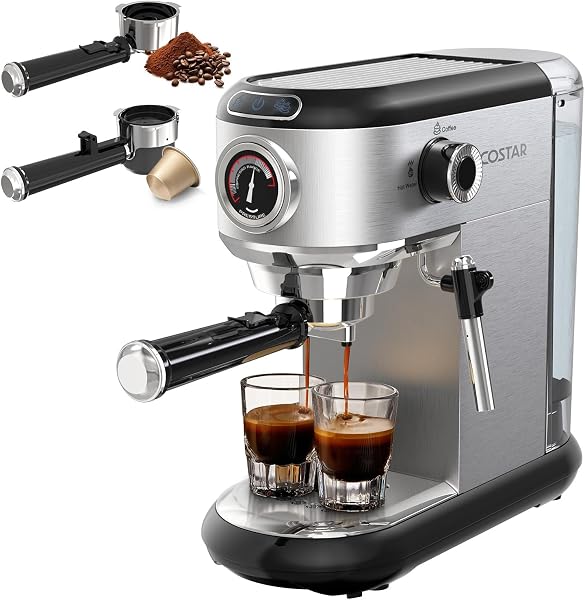
A café-style cappuccino in Bengaluru or Mumbai now costs ₹180–₹260. Do that five times a week and you're spending over ₹4,000 a month on coffee. That's exactly why so many Indian households are looking at a costar coffee maker machine for home — it's one of the few genuinely affordable entry points into brewing fresh coffee at home, with most models sitting comfortably under ₹2,500.
But here's the thing: the budget coffee maker market in India is crowded, listings are confusing, and spec sheets are often copy-pasted from one product to another. This guide cuts through that. We'll cover what a Costar machine actually does (and doesn't do), the price bands you'll see on Amazon and Flipkart, which models make sense for which type of household, how to avoid the common buying mistakes, and exactly when to hit the "buy" button to get the best deal.
Understanding the Costar Coffee Maker Machine for Home Range
Costar is an imported, value-focused brand that sells primarily through online marketplaces in India. Its catalogue is dominated by drip filter coffee makers — the kind where water is heated in a reservoir, dripped over a bed of ground coffee held in a filter basket, and collected in a glass carafe below. If you've used a South Indian filter coffee apparatus or a hotel breakfast buffet machine, you already understand the mechanism.
A typical Costar drip coffee maker for home runs on 500–800 watts, brews between 4 and 12 cups per cycle (roughly 600 ml to 1.8 litres), and comes with a reusable nylon or mesh filter basket, a glass carafe with a keep-warm hot plate, and a simple on/off switch or a basic mechanical dial. Some higher-priced listings add a digital display, programmable timer, or a stronger keep-warm element.
Alongside the drip machines, you'll also find listings marketed as "Costar espresso coffee machine" or "semi-automatic coffee maker." Be careful here. Some of these are genuinely pump-driven espresso units with a portafilter, while others are drip machines with a frother attachment on the side. The distinguishing detail is the portafilter — a metal handle with a basket that you fill and tamp. No portafilter means no espresso, regardless of what the title says.
What Costar does not offer is the fit-and-finish of a Philips or De'Longhi, or the service network depth of a Bajaj. What it offers is a functional, low-cost way to make 4–6 cups of fresh coffee every morning without spending ₹8,000–₹15,000. For a first machine, a rented flat, a small family, or a household testing whether home brewing will actually stick, that trade-off is often sensible.
Why a Costar Coffee Maker Machine for Home Suits Indian Kitchens
Filter coffee is deeply embedded in Indian food culture, especially in the South, and drip brewing is exactly the method that produces that style of decoction. A Costar drip machine gives you a similar extraction — slow, gravity-fed, no pressure — so the resulting brew works well as a base for milk-based coffee, which is how most Indian households actually drink it.
There are practical advantages too. The machines are compact enough (most are under 25 cm wide) to sit on a kitchen counter in a 1BHK without dominating the space. They run on standard 230V/50Hz supply with a 6A plug, so no special wiring is needed. Power draw is modest — a 600W machine used for 30 minutes a day works out to roughly 0.3 units, which is about ₹70–₹80 a month at typical urban tariffs. And because they use a reusable filter basket, there's no recurring cost for paper filters, unlike many imported drip machines.
Key Factors to Consider Before Buying a Costar Coffee Maker Machine for Home
1. Brewing type: drip vs espresso
Decide this first because it changes everything downstream. If you drink milk coffee, filter coffee, or Americano-style black coffee, a drip machine is the right call — it's cheaper, easier to clean, and brews larger quantities in one go. If you specifically want espresso shots, cappuccino with thick microfoam, or lattes, you need a pump-driven machine with at least 15 bars of pressure, and your budget needs to move up to the ₹4,500+ band. Buying a drip machine expecting espresso is the single most common disappointment in this category.
2. Capacity and household size
As a rule of thumb: 4-cup models (about 600 ml) suit one or two people; 6-cup models (roughly 900 ml–1 litre) suit a family of three to four; 10–12-cup models (1.5–1.8 litres) are for joint families, small offices, or people who entertain often. Remember that a "cup" in coffee-maker specs is typically 100–125 ml, not the 200 ml mug you actually pour into. A "10-cup" machine realistically fills about 5–6 mugs.
3. Keep-warm plate and auto shut-off
Almost all Costar models have a warming plate, but the quality varies. A good one holds coffee at 75–80°C without scorching it. Cheap hot plates keep pushing heat into the carafe and turn coffee bitter within 20 minutes — the compound responsible is the same one that makes over-boiled coffee taste burnt. Look for a model with an auto shut-off timer (usually 30–40 minutes) and, as a habit, transfer leftover coffee to a thermos flask rather than leaving it on the plate.
4. Filter type and cleaning access
Most Costar machines ship with a permanent nylon mesh filter basket plus a removable filter holder. This is good for your wallet and the environment, but the mesh traps fine coffee particles and needs rinsing under a tap immediately after brewing — if it dries, the residue is stubborn. Check whether the filter basket, carafe, and lid are listed as dishwasher-safe. Also check whether the water reservoir is accessible for descaling; a narrow opening makes monthly cleaning a chore.
5. Wattage, build quality and warranty
500–800W is standard for drip machines and heats a full reservoir in 5–8 minutes. Anything advertised at 200–300W will be slow. On build, expect ABS plastic bodies in this price range — that's fine, but check that the carafe is borosilicate glass rather than ordinary glass, since thermal shock from a hot plate can crack the cheaper stuff. Warranty on most Costar models is 1 year; before buying, search for an authorised service centre in your city. If there isn't one, factor in that a fault may mean a courier-based replacement rather than a local repair.
Costar Coffee Maker Machine for Home — Top Picks at Different Price Points
Prices below reflect typical Amazon India and Flipkart listings and move with sales, seller, and colour variant. Treat them as bands, not fixed quotes, and always confirm on the product page before ordering.
1. Costar 600W Drip Coffee Maker with Glass Carafe (Budget Pick) — ₹1,199 to ₹1,699
This is the most common Costar configuration: a 600W drip brewer, roughly 1.25–1.5 litre capacity (6–10 cups), glass carafe with a marked water gauge, reusable mesh filter basket, warming plate, and a simple rocker switch. There's no timer, no display, no programming — you fill, switch on, and wait about six minutes.
For a first machine, this is the sensible entry. It does one thing competently, and at this price the risk is low. The café-style coffee it produces with a medium-coarse South Indian filter blend (typically 80:20 coffee-to-chicory) is genuinely good — arguably closer to traditional filter coffee than what a ₹12,000 espresso machine produces, because the extraction method is the same. Clean-up is three parts: rinse the basket, wash the carafe, wipe the plate.
Pros: Lowest entry cost; reuses your own ground coffee with no capsules; brews 4–6 mugs in one cycle; low power draw; compact footprint; easy to replace if it fails.
Cons: No timer or auto-start; thin plastic lid on some units; carafe and hot plate need careful handling; brew strength isn't adjustable; no audible "done" signal on most variants.
2. Costar Drip Coffee Maker with Keep-Warm & Anti-Drip Feature (Mid-Range Pick) — ₹1,799 to ₹2,599
Step up a band and you generally get a better hot plate with an auto shut-off, an anti-drip valve that lets you pull the carafe mid-brew without spilling onto the plate, a water-level window on the outside of the reservoir, and slightly better plastic finishing. Some listings in this range add a reusable stainless steel mesh filter instead of nylon, which is more durable and doesn't retain odours.
This is the sweet spot for a family of three or four. The anti-drip valve sounds like a small feature but it's the one you'll appreciate every morning — with the budget model, pulling the carafe early means coffee drips directly onto the hot plate and bakes on. The auto shut-off matters for anyone who leaves for work in a hurry and forgets things.
Pros: Anti-drip valve; auto shut-off; external water gauge; more durable filter; still well under ₹3,000.
Cons: Still no programmable timer; plastic body can discolour near the hot plate over 2–3 years; carafe replacement parts are hard to source in India.
3. Costar Espresso / Semi-Automatic Coffee Machine with Milk Frother (Premium Pick) — ₹4,000 to ₹7,999
If your goal is cappuccino, latte, or a proper espresso shot, this is the band to shop in — and the only Costar tier where you should insist on a portafilter and a pressure rating of at least 15 bars. Models here typically include a 1.2–1.5 litre removable water tank, a steam wand or panarello frother, single and double shot baskets, and a drip tray.
Be realistic about what you're getting. At ₹5,000, the steam wand will produce foam, but it will be coarser and less stable than a ₹20,000 machine's, and temperature stability across back-to-back shots will drift. You'll also need a burr grinder (₹2,500–₹5,000) and ideally a kitchen scale, because pressurised baskets are unforgiving of inconsistent grind. Factor that into the total cost — the machine is only part of the spend.
Pros: Real espresso extraction; milk frothing for cappuccino and latte; removable tank makes refilling and cleaning easier; cheaper than any mainstream branded espresso machine.
Cons: Needs a separate grinder to perform well; steeper learning curve; cleaning the group head and steam wand after every use is non-negotiable; service support is the weakest link at this price.
Costar Coffee Maker Machine for Home — Comparison Table
| Feature | Budget Drip (₹1,199–₹1,699) | Mid-Range Drip (₹1,799–₹2,599) | Espresso / Semi-Auto (₹4,000–₹7,999) |
|---|---|---|---|
| Brew type | Gravity drip filter | Gravity drip filter | Pump-driven espresso (15 bar+) |
| Capacity | 1.25–1.5 L (6–10 cups) | 1.5 L (10 cups) | 1.2–1.5 L tank, 1–2 shots per pull |
| Wattage | 600 W | 600–800 W | 800–1,100 W |
| Filter | Reusable nylon/mesh basket | Reusable steel mesh basket | Pressurised single & double baskets |
| Keep-warm plate | Yes, manual switch-off | Yes, with auto shut-off | No (cup warmer on some models) |
| Anti-drip valve | Usually no | Yes | Not applicable |
| Milk frother | No | No | Yes (steam wand) |
| Best for | Singles, couples, first-time buyers | Families of 3–4, daily use | Espresso and milk-coffee drinkers |
| Extra spend needed | None | None | Grinder ₹2,500+ |
Pros and Cons of the Costar Brand, Honestly Stated
What works in Costar's favour
- Price-to-function ratio: You get a working drip brewer at a fifth of what a branded machine costs. For a category where many people use the machine four times a week and then abandon it, that matters.
- Zero consumable cost: The reusable filter basket means you buy ground coffee and nothing else. No capsules at ₹35–₹50 a pop.
- Simple enough to use without reading the manual: Fill water, add coffee, switch on. No pressure gauges, no pre-infusion settings, no dialling in.
- Easy online replacement: Amazon and Flipkart both offer 7–10 day replacement windows. Test the machine thoroughly inside that window.
Where you should temper expectations
- Service network: This is the genuine weak point. Unlike Bajaj or Philips, Costar doesn't have walk-in service centres in most Tier-2 and Tier-3 cities. A fault usually means a marketplace return, not a repair.
- Build longevity: Expect 2–4 years of daily use, not a decade. The hot plate coating and plastic hinges are the first things to go.
- Parts availability: Broken carafes are difficult to replace. Handle the carafe carefully — this is the number-one failure point across all budget coffee makers.
- Spec-sheet inconsistency: Listings sometimes show the same product image across different wattages and capacities. Cross-check the capacity in the product description against the model number in the title.
Where and When to Buy a Costar Coffee Maker Machine for Home
Amazon India vs Flipkart
Both stock Costar models, and the price gap between them is usually ₹100–₹300. Check both before ordering — and importantly, check the seller, not just the price. On Amazon, look for listings fulfilled by Amazon (FBA) rather than a third-party seller shipping directly, because returns and replacements are far smoother. On Flipkart, look for "F-Assured" tags.
Also compare the effective price after bank offers. Amazon frequently runs 10% instant discounts on HDFC and ICICI credit cards; Flipkart runs similar offers on Axis and SBI cards. On a ₹1,500 machine, a 10% bank discount plus a ₹100 coupon can bring the price down to around ₹1,250.
The best times to buy in the Indian sale calendar
- Amazon Great Indian Festival and Flipkart Big Billion Days (September–October): The deepest discounts of the year on small appliances, often 25–40% off MRP. This is the single best window.
- Amazon Prime Day (July) and Flipkart's mid-year sales: Good but usually a notch below the festive sales.
- Republic Day sale (January): Decent pricing, often bundled with exchange offers.
- Regular weekday mornings: Even outside sales, prices on budget appliances frequently dip mid-week rather than on weekends. Track the price for a week before buying.
Test it within the return window
The moment it arrives, do a full brew cycle with plain water, then a real brew. Check four things: does the machine leak at the carafe seam, does the hot plate heat evenly, does the auto shut-off actually trigger, and does the filter basket seat properly without wobbling. If any of these fail, raise a replacement request the same day rather than waiting. Also retain the box for at least 10 days — replacements often require original packaging.
Real-World Usage Tips for Indian Consumers
Use filtered or RO water, not borewell water
Hard water is the leading cause of premature death in Indian coffee makers. The calcium carbonate in borewell or municipal hard water scales up the heating element within months, slowing brew times and eventually killing the machine. Use RO or filtered water — it costs almost nothing per brew and roughly doubles the machine's usable life.
Descale once a month in hard-water areas
Fill the reservoir with a 1:1 mix of white vinegar and water, run a brew cycle without coffee, then run two full cycles with plain water to flush. Do this monthly if you're in Delhi, Chennai, Jaipur, or anywhere with hard supply; every two to three months if your water is soft. Skip this and
Affiliate Disclosure:
This post contains affiliate links. We may earn a commission when you purchase through our links, at no extra cost to you.
Share this:


