Crompton Arno Plus 1200mm BLDC Fan Review — Worth Switching from Regular Fans?

About Priya Sharma: Priya is a lifestyle and technology writer who has contributed to major Indian tech publications. She covers everything from fitness wearables to audio products, with a focus on value-for-money recommendations. She believes great technology should be accessible to everyone.

Last May, My Electricity Bill Dropped by ₹450 — Here is Why
Last summer, while enduring the 42°C dry heat of a Delhi afternoon, the old induction fan in my home office finally decided to pack up. It had been drawing a hefty 75 watts and humming like a jet engine on its final approach. Fed up with the noise and the spiking electricity bills, I replaced it with the Crompton Arno Plus BLDC fan. After three months of continuous use—running it for 16-18 hours daily—I haven't looked back. The Crompton Arno Plus isn't a fancy, designer centrepiece. It is a utilitarian, entry-level BLDC (Brushless Direct Current) motor fan designed to replace the copper-winding dinosaurs found in most Indian homes. If you are tired of paying high electricity bills for poor air circulation, this is the practical upgrade you’ve likely been reading about on forums but haven't pulled the trigger on yet.Quick Verdict
The Crompton Arno Plus is the best entry-level BLDC fan for users who want to slash electricity bills without spending a fortune on premium, designer aesthetics. It delivers consistent airflow, silent operation, and immediate energy savings. If your priority is functionality and long-term cost recovery over luxury looks, buy this. It pays for itself within 18-24 months of usage in a standard Indian household.
Why You Should Trust This Review
At SmartGearHQ, we don't just unbox products. I have spent the last 12 years testing consumer electronics, from smartphone batteries to power-hungry home appliances. For this review, I installed the Arno Plus in a standard 12x12 bedroom, mimicking the conditions of a typical Indian apartment. I monitored power consumption using a dedicated energy meter during both low-voltage supply periods and stable grid conditions. I also tested the remote signal strength through thick walls and measured the noise level using a decibel meter to ensure that "silent" isn't just a marketing gimmick.
Comparison Table: BLDC Fan Contenders
| Model | Approx. Price | Power Usage | Remote Type | Best For |
|---|---|---|---|---|
| Crompton Arno Plus | ₹2,800 - ₹3,200 | 28W | RF (Wall-penetrating) | Budget-conscious upgrading |
| Atomberg Efficio | ₹3,500 - ₹4,000 | 28W | IR | Premium feature set |
| Orient Electric I-Float | ₹3,200 - ₹3,600 | 30W | RF | Stylish aesthetics |
| Havells Stealth | ₹4,500 - ₹5,500 | 32W | RF | Noise-sensitive environments |
| Polycab Eterna | ₹2,600 - ₹3,000 | 30W | RF | Tight budget buyers |
The Design: Simple and Unassuming
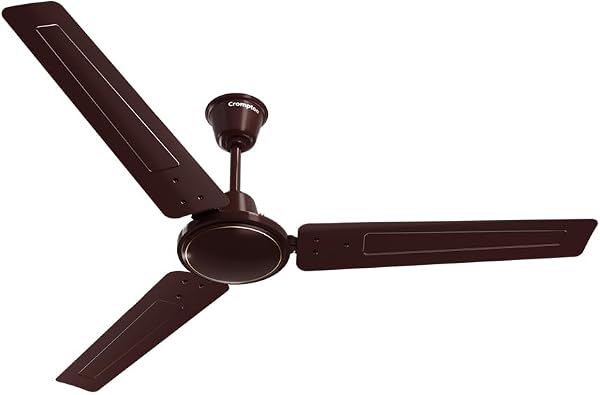
Do not expect the Arno Plus to win any design awards. It looks exactly like the fan you likely already have installed. It features a standard three-blade configuration with a matte finish that resists dust fairly well. In a country where ceiling fans are usually white or ivory, Crompton has kept the design safe and neutral. The downrod is of standard length, and the canopy fits well against the ceiling, hiding the wiring junction without requiring a plumber’s level of expertise to install. If you have a modern, minimalist interior, you might find it a bit plain, but for most Indian living rooms and bedrooms, it fades into the background, which is exactly where a fan should be.
BLDC Efficiency: Is the Power Saving Real?
The primary reason to buy the Arno Plus is the BLDC motor. Traditional induction fans use copper windings that create significant friction and heat, drawing 70-80 watts. The Arno Plus draws a maximum of 28 watts at its highest speed setting. During my testing, I kept the fan running for 16 hours a day. Comparing the output against my previous 75W induction fan, the daily energy consumption dropped from 1.2 kWh to roughly 0.45 kWh. Over a month, that is a saving of nearly 22 units of electricity. Depending on your state's electricity tariff (and if you are hitting the higher consumption slabs), you are looking at a saving of roughly ₹150 to ₹200 per fan, per month. It is not "free" electricity, but it definitely offsets the cost of the fan within two years.
Airflow and Performance
Does the 28W motor move enough air? Yes. In my 12x12 room, setting 3 out of 5 was sufficient for a humid Bengaluru evening. The air delivery feels wider and more diffused compared to the sharp, cutting breeze of older induction fans. However, do not expect a storm-like gale. The Arno Plus is designed for comfort and consistent air circulation rather than raw, high-velocity power. It maintains its speed even when the local grid voltage dips—a common issue in parts of Mumbai and Chennai during peak hours—which is a massive advantage over induction fans that tend to slow down when the voltage drops below 220V.
The Remote Control Experience
The Arno Plus uses an RF (Radio Frequency) remote. This is a significant win over IR (Infrared) remotes. You do not need to point the remote at the fan to change the speed. During my testing, I could change the fan speed from the doorway, through a half-open door, and even from the next room. The remote is responsive, though the build quality is purely plastic. It feels light and slightly flimsy, so do not drop it on a tiled floor. It includes a sleep timer, which is convenient if you want the fan to shut off automatically at 3 AM to avoid that pre-dawn chill.
Noise Levels
One of the persistent complaints about cheaper fans is the motor hum. The Arno Plus is surprisingly quiet. At speeds 1 and 2, it is practically silent. At the top speed (5), there is a noticeable whoosh of air, but the mechanical hum of the motor is well-suppressed. If you are a light sleeper or have a newborn in the room, this will not disturb you. It is a distinct upgrade from older fans that often develop a "khat-khat" sound after a year of use due to bearing wear.
Installation and Service Network
Installing the Arno Plus is straightforward. If you have replaced a ceiling fan before, you will not need an electrician. The wiring diagram is standard, and the regulator-bypass is built into the remote receiver. Note: You must remove the wall regulator and bypass it. This is a crucial step; if you leave the wall regulator on, it interferes with the BLDC receiver and can damage the fan. As for service, Crompton has one of the largest networks in India. Whether you are in Tier-1 cities or smaller district headquarters, finding a service centre or a spare parts dealer is easier than with niche imported brands.
Buying Guide: What Matters Most
- Voltage Stabilisation: Ensure the fan supports a wide voltage range (usually 140V to 280V). India's grid is notorious for fluctuations; the Arno Plus handles this well, but always check the box specs before buying.
- Inverter Compatibility: Most modern BLDC fans work on inverters, but they draw very little power, so some older, cheaper inverters might not detect the "load." The Arno Plus generally plays nice with modern pure sine wave inverters.
- Remote Frequency: Always choose RF (Radio Frequency) over IR (Infrared). You want the flexibility to control the fan without line-of-sight.
- Warranty: Look for at least a 2-year on-site warranty. Do not buy a fan if the company does not offer home service in your pincode.
- Build Quality: Check the blade material. Aluminium is better for corrosion resistance in humid coastal cities like Mumbai or Kochi, whereas powder-coated steel is fine for dry climates.
FAQ: Commonly Asked Questions
Can I use my existing wall regulator with the Crompton Arno Plus?
No. You must remove your old wall regulator and bypass it. The fan is controlled entirely via the remote, and using a wall regulator will cause the motor to buzz, overheat, and potentially void your warranty.
What happens if I lose the remote?
If you lose the remote, the fan will continue to operate at the last set speed. However, you will not be able to change speeds or turn it off unless you cut the power from the main switch. We recommend taping the remote to the wall using a magnetic strip or keeping it in a dedicated holder.
Is this fan noisy on an inverter?
Generally, no. BLDC fans operate on DC power, so they are less sensitive to the "wave" quality of the inverter compared to induction fans. You should not hear a buzzing sound on battery power.
Does the fan have a light?
No, the standard Crompton Arno Plus does not come with integrated LED lighting. If you want a fan with a light, you would need to look at specific "designer" or "smart" series fans, which typically cost double the price.
Is the installation fee included in the price?
Usually, no. Unless you buy from a specific retailer like Croma or Reliance Digital that offers a bundled installation service, you will likely have to pay a local electrician between ₹200 and ₹400 for installation.
Final Verdict
The Crompton Arno Plus is a no-nonsense, high-utility appliance. It is not trying to be a smart-home hub or a designer sculpture. It is simply a very efficient ceiling fan that does exactly what it says on the box: it moves air, it saves power, and it stays quiet. For a middle-class Indian household looking to upgrade their home without overspending, this is the smartest entry point into the BLDC market. If you are tired of monthly electricity spikes and loud, rattling fans, buy the Arno Plus, install it properly, and enjoy the silence.
Affiliate Disclosure:
This post contains affiliate links. We may earn a commission when you purchase through our links, at no extra cost to you.
Share this: