Narwal Freo X10 Pro Robotic Vacuum Cleaner for Home: Complete India Buying Guide (2025)

About Rahul Verma: Rahul is a tech enthusiast and gadget reviewer with over 8 years of experience testing consumer electronics. He specializes in audio gear, smartwatches, and mobile accessories. When he is not testing products, you will find him exploring the latest in AI and smart home technology.
You vacuum on Sunday morning. By Wednesday, the floor has that familiar grey film again — a fine layer of dust that seems to regenerate overnight, especially if you live in Delhi NCR, Mumbai, or any city where windows stay open and construction never really stops. For Indian households with marble, vitrified tiles, a couple of rugs, and a shedding pet or a toddler, a manual vacuum-and-mop routine is a losing battle.
That is exactly the gap the narwal freo x10 pro robotic vacuum cleaner for home is designed to fill — a flagship-grade robot that vacuums, mops, washes its own mop pads with hot water, empties its own dustbin, and refills its own water tank. But at a street price that typically sits between ₹59,999 and ₹74,999 in India, it is not an impulse buy. This guide breaks down what the machine actually does, how it compares with alternatives at lower and higher price points, where to buy it in India for the best value, and whether it genuinely suits Indian flooring and dust conditions.
What Is the Narwal Freo X10 Pro Robotic Vacuum Cleaner for Home?
Narwal is a Chinese robotics company that built its reputation on one specific idea: mopping should be as serious as vacuuming. Most robot vacuums drag a damp cloth around; Narwal's Freo series uses dual rotating mop pads that spin against the floor under downward pressure, then return to a base station that scrubs the pads with hot water and dries them with warm air. The narwal freo x10 pro robotic vacuum cleaner for home is the brand's current premium model in that lineage, sold in India through Amazon, Flipkart, and Narwal's own India store.
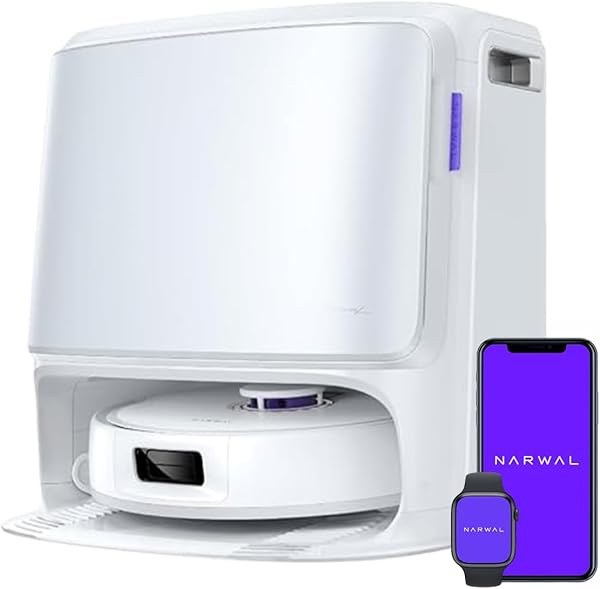
In practical terms, it is a two-in-one floor-care system. The robot itself is a low-profile disc that navigates your home using LiDAR mapping, vacuums dry debris into an onboard bin, and mops behind itself. The base station is the size of a small side table and handles the dirty work: it sucks dust out of the robot into a sealed bag, sprays the mop pads with hot water to wash them, dries them, tops up the robot's clean water tank, and doses detergent automatically.
What that means for you is a machine you interact with roughly once a week rather than once a day. You empty a bag every month or two, refill a clean-water tank every few days, and let the robot run on a schedule.
Key specifications at a glance
- Suction: Up to 22,000 Pa (brand-claimed), with adjustable levels and an auto carpet-boost mode
- Mopping: Dual rotating pads with downward pressure, auto mop-lift when it detects carpet
- Base station: Auto dust emptying, hot-water mop washing, hot-air drying, auto detergent dosing, clean-water refill
- Navigation: LiDAR (dToF) mapping with 3D structured-light obstacle avoidance
- Battery: Roughly 6,400 mAh, rated for around 150–180 minutes of run time (about 180–250 sq m on a single charge in real conditions)
- App and voice: Narwal app with multi-floor maps, no-go zones, room-specific schedules; works with Alexa and Google Assistant
- Height: Slim enough — around 10–11 cm — to slide under most Indian sofas and low beds
Note: specifications are as published by Narwal and can vary by variant and firmware. Always confirm the exact configuration on the live Amazon or Flipkart listing before ordering, since bundles and offers change frequently.
Why Indian Homes Need a Robot Vacuum Like This
Indian dust is not the same as European dust. It is heavier, grittier, and arrives in larger volumes — road dust, construction silt, agarbatti ash, kitchen flour spills, and pet hair all in the same 24-hour window. A basic robot with a single side brush and a drag mop will spread that grit around rather than pick it up, which is why so many first-time buyers end up disappointed.
The narwal freo x10 pro robotic vacuum cleaner for home is built for higher-dust environments. The rotating mop pads scrub rather than smear, so a thin film of settled dust on marble actually gets lifted instead of being pushed into a corner. The auto dust-emptying station matters even more in Indian homes: a standard onboard bin fills up in two or three rooms during peak dust season, which means you would otherwise be emptying it daily.
There is also the question of hard water. Most Indian cities supply water with high TDS, and that leaves mineral residue on tiles if a mop dries while wet. Hot-water washing plus hot-air drying at the base station prevents the pads from sitting damp and smelling musty — a genuine problem during the monsoon.
Key Factors to Consider Before Buying
1. Suction power versus real-world pickup
Brands compete on Pascal numbers, and 22,000 Pa sounds dramatic next to a 5,000 Pa model. But raw suction figures are measured at the inlet and rarely translate one-to-one on the floor. What actually matters is airflow combined with brush design and how many passes the robot makes. Read the reviews for hard-floor and pet-hair performance rather than buying on the Pa number alone.
2. How the mopping actually works
A spinning-pad mop is far more effective on Indian tile and marble than a vibrating flat plate, and both beat a passive drag cloth. Check whether the robot lifts its pads when it transitions from tile to rug — otherwise you will be drying a wet patch on your carpet every single day. The Freo X10 Pro lifts and raises the pads automatically, and you can also set no-mop zones in the app.
3. What the base station really automates
"Self-emptying" and "self-cleaning" sound similar but are different features. Self-emptying means dust moves from the robot into a bag in the base. Self-cleaning means the mop pads get washed. A good flagship does both, plus hot-air drying and detergent dosing. If you have to wash the pads by hand every night, you have not really automated anything.
4. Navigation and obstacle avoidance
Look for LiDAR or dToF mapping — it builds a reliable floor plan and lets you set room-specific cleaning. Structured-light or camera-based obstacle avoidance helps the robot dodge phone chargers, pet bowls, and loose footwear, which matters in busy Indian homes where the floor is a storage area.
5. App quality and Indian support
Check the app's language support, whether it works reliably on Indian Wi-Fi routers (2.4 GHz-only is common), and whether the brand has a service presence in India. A robot without local warranty service is an expensive paperweight if a motor fails.
6. Consumables and long-term cost
Dust bags, mop pads, filters, side brushes, and cleaning detergent are recurring costs. Ask the seller about spare availability before you buy — this is the single most overlooked factor in Indian robot vacuum purchases.
Narwal Freo X10 Pro: Detailed Feature Breakdown
Cleaning performance on Indian flooring
On vitrified tiles and marble — the two most common living-room surfaces in Indian apartments — the Freo X10 Pro performs comfortably in the flagship bracket. The combination of strong suction with a rotating rubber-and-bristle brush means it lifts fine silt and larger debris (rice grains, biscuit crumbs, dried leaves from the balcony) without scattering. On thin cotton dhurries and low-pile rugs, the auto carpet-boost kicks in and the mop pads lift clear of the fabric.
Where it struggles, as most robots do, is with high-pile shaggy rugs and with tangles from very long hair. If your household has three family members with waist-length hair, plan to cut hair off the brush roll every couple of weeks.
The mopping system
The rotating mop pads press down as they spin, which is what separates this class of machine from cheaper drag-mop robots. Coffee spills, dried atta patches near the kitchen entrance, and light kitchen oil film all come up reasonably well on a second pass. Heavily set stains from turmeric or old oil will still need a manual scrub — no robot replaces a hand-scrub for that.
The base station
This is where most of the money goes. The station washes the pads with hot water after every mopping run, dries them, seals dust into a bag, and keeps the robot topped up. Expect to change the dust bag roughly every 45–75 days in a typical Indian apartment, and to refill the clean-water tank every two to four days depending on how much area you mop.
Navigation, app, and scheduling
Mapping is fast and stable. The app supports multi-floor maps, room-by-room cleaning, no-go zones, virtual walls, and per-room suction and mop settings. You can schedule a daily 8 a.m. vacuum-only run and a twice-weekly mop, which is the pattern most Indian households settle into. Voice control through Alexa or Google Assistant works for starting, stopping, and sending the robot home.
Pros and Cons of the Narwal Freo X10 Pro
What works well
- Genuinely hands-off mopping — hot-water pad washing and drying make the biggest difference in Indian dust and humidity conditions
- Strong suction with an auto carpet mode — handles the tile-to-rug transition without soaking the rug
- Reliable mapping — multi-floor support is useful for duplexes and independent houses
- Good height clearance — gets under most Indian sofas and beds where dust accumulates fastest
- Sealed dust bag — no dust cloud when you empty it, which matters for allergy-prone households
What to think twice about
- Premium price — it costs roughly two to three times a competent mid-range robot vacuum
- Base station footprint — you need a clear wall space of roughly 60 × 50 cm plus clearance in front, which is tight in small Mumbai or Bengaluru flats
- Consumable dependency — bags, pads, and Narwal's detergent are not cheap and are easiest to source online
- Not a replacement for deep cleaning — corners, skirting boards, stairs, and balconies still need manual attention
- Long-hair tangles — the brush roll needs periodic cleaning in hair-heavy homes
Best Robotic Vacuum Cleaners at Different Price Points in India
If the narwal freo x10 pro robotic vacuum cleaner for home is at the top of your shortlist, it helps to see what you get if you spend less — and what the extra money actually buys.
Under ₹30,000: entry-level automation
Models like the Xiaomi Robot Vacuum-Mop series and the Dreame D-series give you LiDAR mapping, app control, and basic mopping for around ₹19,999–₹29,999. You will usually empty the bin yourself, wash the mop cloth by hand, and accept weaker suction. Best for first-time buyers testing whether a robot fits their routine, or for a single-room setup.
₹30,000–₹50,000: the value sweet spot
This is where Indian buyers get the most for their money. The Xiaomi Robot Vacuum X20 Max and Ecovacs Deebot N-series models in this band offer 8,000 Pa-class suction, rotating mops, and in some cases self-emptying bases. You still wash mop pads manually in most cases, but vacuuming becomes genuinely automatic.
₹50,000–₹70,000: full self-maintenance
The Narwal Freo X Ultra, Ecovacs Deebot T30 Pro Omni, and Dreame L-series Ultra models sit here. You get self-emptying, hot-water mop washing, and hot-air drying — the complete automation loop. This is the bracket where the experience changes from "a robot I maintain" to "a robot that maintains itself."
₹70,000 and above: flagship
The Narwal Freo X10 Pro, Roborock Q Revo series, and Narwal Freo Z Ultra occupy this tier. You are paying for stronger suction, better obstacle avoidance, larger base stations, and more polished app software. Worth it if you have a large apartment (1,200+ sq ft), pets,
Affiliate Disclosure:
This post contains affiliate links. We may earn a commission when you purchase through our links, at no extra cost to you.
Share this: